Wednesday, July 31, 2013

Encounters - The Creation of New Zealand A History - Paul Moon (Penguin)

I own a house, and a small parcel of land, ti which I paid the current market rate for, slap bang in the middle of an old swamp. It was once known as Aglionville. Now it's known as Alicetown, after a prominent settler, by the name of Alice. On first meeting me, people often ask where I live. They need a sense of place to locate me and everyone else on their own map of the world. Where they live, in relation to me determines their status in society, it reaffirms their own choice of location, it identifies their cultural tribe, their clique, it helps to build their identity. And every one they meet is equally assessed. This is not a Western phenomenon. Maori do it too. They talk about them selves in terms where they are from - their mountain, their river, their whakapapa. All of this helps to determine who we are as individuals and where we sit in the world.
Massey University has a TV jungle "Find your place in the world", as if potential students don't know who they are, or where they belong. Only academic study and collegiate camaraderie can suitably direct their un-positioned compasses.

American author Walt Whitman referred to the great 'Yawl!"; A concept of standing on a rock, high up in the wilderness and balling out to the trees and rivers. The American identity, he believed was encapsulated by nature, the pioneer spirit and the yearning for freedom in the wild, escaping the squalor and oppression of the cities.

Playwrite Greg MCGee charged his most famous character, Foreskin, when addressing an after match rugby function, with the most profound question in all of our literature to date" "What are ya?"
Who are we, indeed? That question of identity - real, imagined and desired is a pivotal question in Paul Moons new book "Encounters'. In his chapters, Moon explores the historical identity of our land and our people. Who were they? Who are they and what did we think of our selves as we journey through time. He looks at the Maori mythical explanations of how this country was first settled and the later misguided interpretations of European academics, with agendas of racial purity and Christian morality. He also looks at the imagined identity of New Zealand. The creation and selling of land parcels, some of which still exist today, by the New Zealand Company from maps drafted in London, never locally surveyed, impresses upon history the desires to escape the old world for the new yet reinforces the Victorian arrogance that because they were British the early settlers could just arrive and set up without any question of challenge from the current occupants.

Later, Moon tackles the question of physical geography. New Zealand's literacy tradition and it cinema of unease endlessly refers to the ways in which the land shape us. The weather, the earthquakes, the sea and the mountains all enclose and embrace us. I recently heard a comment that New Zealanders are not tolerant in large crowds, such as 2 hour queues for rides at Disneyland, because we are so use to the sparseness of population and the vast ness of open spaces. Yet at the same time it would be difficult to move far in any town or city without encountering the encircling hills, or meeting the ocean or having to ford a river. The land and its infinite natural incarceration can not be escaped. Even in the densest city areas a mountain or a river is close by and can even be seen out of the nearest window.

Finally, he looks to the future. With the resurgence of Maoritanga and Te Reo, the new respect for ANZAC day and New Zealand's involvement in the wars and our ongoing battle to 'punch above our weight' in the international arena. Almost sine the beginning New Zealand has been identified by its commercial prospects. The need to get our produce onto the pantries of Europe, Britain and now in Asia has driven innovation, inventions such as the freezer ships and milk biscuits, the electric fence and a strew of agricultural products. Yet the invention that most sums up our ongoing desire to mix history with the present, honouring the past, embracing it, repackaging it and laying it down for interpretation and identity is the Garmon GPS. This humble in car navigation device contains all the maps, place names and landmarks of our country and many others. It is a very small device yet it can identify any land parcel, any road, any street and tell you who lives there, the proximity to the township, and from that one can speculate on many things about who they are. And despite the ethereal make up of pixels and data the implicit history and identities encapsulated are real and imagined, mythical and legitimate. It is the ultimate map, and like the land always changing and always reinterpreting - just like our history.

'Throughout its human history, New Zealand has been interpreted and experienced in often radically different ways. Each wave of arrivals to its shores has left its own set of views of New Zealand on the country – applying a new coat of mythology and understanding to the landscape, usually without fully removing the one that lies beneath it.' Encounters is the wide-ranging, audacious and gripping story of New Zealand's changing national identity, how it has emerged and evolved through generations. In this genre-busting book, historian Paul Moon delves into how the many and conflicting ideas about New Zealand came into being. Along the way, he explores forgotten crevices of the nation's character, and exposes some of the mythology of its past and present. These include, for example, the earliest Maori myths and the 'mock sacredness' of the All Blacks in the twenty-first century; the role of nostalgia in our national character, both Maori and Pakeha; whether the explorer Kupe existed; the appeal of the Speight's 'Southern Man'; and ruminations on New Zealand art and landscape. What results is an absorbing piece of scholarship, an imaginative and exuberant epic that will challenge preconceptions about what it means to be a New Zealander, and how our country is understood. Lyrical, breathtaking and provocative, and illustrated with artworks throughout, Encounters offers an extraordinary insight into the beginnings of our country.

Sunday, July 28, 2013

Firing up the Kindle - New books available on e-book format

Like everyone, when Kindle format came our I was sceptical.  I couldn't believe that this new tablet format could replace the wonderful tactile nature of a book.  However, having 20-odd titles on my current device, carrying around a couple of magazines and several cookbooks, I could be swayed - a little.  One of the criteria I used for critiquing the titles below was how they translate to the new format from their original paper book layout.  Some do well, some do not.


The Vogue Factor

From Front Desk to Editor

Kirstie Clements
In May 2012 Kirstie Clements was unceremoniously sacked after thirteen years in the editor’s chair at Vogue Australia. Here she tells the story behind the headlines, and takes us behind the scenes of a fast-changing industry.

During a career at Vogue that spanned twenty-five years, Clements rubbed shoulders with Karl Lagerfeld, Kylie Minogue, Ian Thorpe, Crown Princess Mary, Cate Blanchett, and many more shining stars. From her humble beginnings growing up in the Sutherland Shire in Sydney to her brilliant career as a passionate and fierce custodian of the world’s most famous luxury magazine brand, Clements warmly invites us into her Vogue world, a universe that brims with dazzling celebrities, fabulous lunches, exotic locales and of course, outrageous fashion.

Amidst the exhilaration and chaos of modern magazine publishing and the frenzied demands of her job, Clements is always steadfast in her dedication to quality. Above all, she is always Vogue.

Clements' style is an easy read. I'd expect this from a fashion editor.  Her early days could have been the template for the movie "The Devil wears Prada", the flirty chick flick starring Meryl Streep and Anne Hathaway. With that in mind, I'd expect at least a little dirt on the Gaultier.  Yet his light touch steers clear of the really serious issues.  Clements talks about how she runs interference across a variety of issues such as anorexia, exploited models, outrageous photographers and blatantly commercially minded sponsors.  None of this was new,  What I really missed was how she could have transformed the industry, or convinced designers to ditch their ridiculous notion that women with the waists of five year olds are sexy, desirable or even possible.  I really wanted an honest expose - alas I got a nice, reminiscent and slightly gushy romp through the annals of Aussie fashion industry. 

Another point that missed was Clements' laudable but incredibly isolated rise in fashion publishing.  She seems to have remained only with one journal through her entire career, and that must simply be the main reason why her views are so coloured.  Even now, Clements, who's been recently treading around the traps, promoting the her book, seems reluctant to really get stuck into the meat and bones of her topics.  She clearly doesn't want to upset her former employers.  Perhaps they might withdraw their references.  and this after a very public and un-ceremonial dismissal for a reason that still seems a bit unclear, and certainly undefended in employment law, anyway.

As I read this on my Kindle the irony of reading in electronic format was not lost on me.   “The day is fast approaching when a magazine and its website will only be full of lifts," she wrote,"promotional shots handed out by clients, and staff Instagrams. And there will be a whole tier of upper management scratching their heads, wondering why circulation is tumbling and blaming the editor.” A bleak message, that shows no optimism for any creative for publishing in the new world.  This rejects the efforts of other Aussie mags such as the free music press (Drum mag in particular) which tie in web links, audio and interactive content.  It may be true that the days are numbered for the 10 page fashion spread - but then who really believed that you could wear a $3000 ball gown and Jimmy Choos on a Tahitian surf beach anyway?

The Artisan Market (US edition)

Cure Your Own Bacon, Make the Perfect Chutney, and Other Delicious Secrets

Emma Macdonald
Titles such as Charcuterie, Artisan Cheesemaking at Home, and Whole Beast Butchery have blazed a trail in bringing gourmet deli techniques into the home.
Having grown up on the family's delicious, homemade Cucumber Relish, Emma Macdonald had the simple idea that full-flavored, quality chutneys and preserves needed to be brought to the specialty sector.
Since 1994, Emma and her colleagues at The Bay Tree, have been a key supplier of well over 150 chutneys, pickles, jellies, sauces, dressings and preserves to Britian's network of gourmet delicatessens.
Bay Tree products are carried in leading UK gourmet delis such as Fortnum & Mason and Harvey Nichols.
Home pickling, smoking, curing is a major trend in food.
Two types of recipes are featured in this book - recipes for deli ingredients you can make yourself, and recipes for 'semi-home made' items that make use of deli-bought ingredients.
These are things you wish you learned from your grandmother, but didn't.
Contains 'before and after' photos.

I hope this comes out in paperback format in New Zealand because this American-centric take on mostly European recipes is sorely missing from the Kiwi cook's repertoire.  In recent years American food has taken a bad rap for being over-sugared-over-processed and just plain evil.  But if you think back to the Deli food promised in the TV shows of the 70's - Pastrami on Rye, Kosher food, Chipped Beef and the like then that sends you down a better path.  The Artisan Market sort of approaches that theme, although there is a distinctively new flavour.  This is the work of a commercial caterer, Emma Macdonald, who owns her own establishment, The Bay Tree which specializes in cured meets and pickles.  Yum!  The recipes here are tricks of the trade for the home cook, focussing, in the main on traditional methods with a modern twist.  Like curing your own bacon - I was impressed with how easy this was.  Rubbing smoked salt on Pork Belly is a no brained.  and it's delicious, though not cheap.  Pork Belly is one of the priciest cuts now-a-days.  As is duck.  I won't be confiting anything in the short term on this family budget. 

Mediterranean cheese, made by mixing yogurt and salt was much easier, and affordable.  And a remarkable edition to the home kitchen.  One thing that our Grannies all did was make the most of the cheap cuts and the discarded bits, like peel and egg whites, meat bones, etc.  An artisan kitchen it seems is the upgraded model.  in a world where hunting down a real butcher, taking out a mortgage to pay for the family roast and then trying to perfect a culinary masterpiece in an apartment kitchen the size of a microwave I was a little bemused at the blatant frivolousness of the recipes.  I liked the idea of undergoing a technique and then providing the recipes to use the new ingredient.  But what I didn't like was the outrageous Masterchef quality, out of season, out of store supplies required.  Once, in a simpler time, these things were a dime a dozen.  But thanks to costly, greedy, organic specialist growers, the mass blandness and exclusion of supermarket butcheries and the over bloated demand of high end Gordon Ramsay inspired eateries many of the items in this book are simply unavailable.  Where, for instance can I just pop down to my local fish mongers for a few sardines to cure in salt brine?  Really, even in the US they aren't immediately available.  Are they fresh, native?  In Arkansas? 

Reading a cookbook that was never formatted for the genre is virtually impossible on my kindle, but a little easier on the iPad and Tablet versions, which use full colour photos, at least enhancing the ttext.  Page sizing and placement goes out the window.  Recipes are cut in half or spread out between multiple screens and interspersed with large chunks of black, indecipherable squares.  I presume this was a blackboard concept, with the original text in white font over the top.  But somehow the device has misinterpreted the idea and everything is all deconstructed, like a discarded BLT at the bottom of your lunchbox.  

The book is sound, and apart from the high costs involved with some it on the whole.  Just get the Kindle formatting right, provide alternatives for the cheaper cuts and there could be a winner here! recipes, I enjoyed

Wednesday, July 24, 2013

New Zealand Post Book Awards

Best First Books revealed in New Zealand Post Book Awards

One of New Zealand’s oldest birds wins prize for newest talent

A book about a Moa - that has been described by judges as illuminating, entertaining and utterly original - has won the New Zealand Society of Authors’ Best First Book Non-Fiction prize in the New Zealand Post Book Awards.   We reviewed and IV'd the author a while back.   This is a great book!  Quinn Berentson’s book Moa: The life and death of New Zealand’s legendary bird was singled out by the judges as one of the “best surprises of all the books we read”.
Chief Judge John Campbell said: “Think of Moa as a really great historical biography, in which almost everyone (including the bird itself) is varying degrees of mad.”

The other winners were the Poetry book Graft by Helen Heath and the Fiction book, I Got His Blood on Me by Lawrence Patchett.  I'd definitely be hunting this down!

The overall quality of this year’s Best First Books was so strong that many could easily have been finalists of the New Zealand Post Book Awards in their own right, the judges said.

The category finalists in the New Zealand Post Book Awards will be announced next week, and the winners will be revealed during a star-studded literary awards ceremony in Auckland on 28 August.  What the judges said about the New Zealand Society of Authors (NZSA) Best First Book award winners: 

Graft by Helen Heath (winner of the NZSA Jessie Mackay Best First Book for Poetry award)

“Helen Heath is a candid poet, unflinching, both with what she sees close to her and in the mirror, but capable of great generosity too. Her mother is so beautifully evoked that we feel we know her. Some of the poems are so sad they ache. This is a brave, moving, revealing and assured collection.”

I Got His Blood on Me by Lawrence Patchett (winner of the NZSA Hubert Church Best First Book for Fiction award)

“We congratulate Lawrence on his originality, his skills as a story teller, and the welcome audacity of a short story collection which ranges from playing with history, to magic realism, to a tougher kind of realism entirely: all of it somehow plausible. We can’t wait to see what Lawrence Patchett does next.”

Moa: The life and death of New Zealand’s legendary bird by Quinn Berentson (winner of the NZSA E.H. McCormick Best First Book for Non-Fiction award)

“Moa tells the extinct bird’s story in an exhaustive, scholarly and utterly engaging way. Think of Moa as a really great historical biography, in which almost everyone (including the bird itself) is varying degrees of mad. Illuminating, entertaining and utterly original, Moa is also lovingly presented and was one of the best surprises of all the books we received.”

Wednesday, July 3, 2013

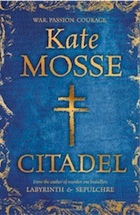
Citadel by Kate Mosse – review

The complex history of the Languedoc has proved fertile territory for Kate Mosse in her recent trilogy of adventure novels, beginning with the phenomenally successful Labyrinth in 2005, shortly to be a mini-series, and now reaching its conclusion in Citadel.
  1. Labyrinth was concerned with the Albigensian crusade and the destruction of the Cathar heresy in the 13th century, weaving historical truth with the legends of the holy grail that flourished after the final massacre of the Cathars at their fortress of Montségur.
This idea of a connection between the story of a secret Cathar treasure and the grail was given substance in the 20th century by the work of Otto Rahn, a German historian and SS officer who believed that the Cathars held the key to the grail mystery, and that the evidence was somewhere beneath the ruins of Montségur. His writings attracted the attention of Himmler, whose own fascination with the occult, and with the possible ancient pedigree of an Aryan race, led to the founding of the Ahnenerbe, a society dedicated to research into proving the historical origins of a master race.

Author Kate Mosse
This Nazi connection provides a richly dramatic setting for Citadel. The novel takes place largely between 1942 and 1944, between the occupation and liberation of southern France.
Mosse has marshalled a large cast of characters, although (as in Labyrinth and its successor, Sepulchre) the story centres around a determined young heroine, in this case 18-year-old Sandrine Vidal, an orphan living with her older sister in Carcassonne. Sandrine is shocked out of her innocence in the summer of 1942 when her life is saved by a young resistance fighter, Raoul Pelletier, just as he discovers that his network has been infiltrated by a spy, Leo Authié, working for the Deuxième Bureau, the French military intelligence agency. When a bomb goes off at a crowded, peaceful demonstration, Raoul realises he has been set up by Authié to look like the perpetrator. He goes on the run, aided by Sandrine and her sister, Marianne, who is already working with the resistance.
But Authié wants Raoul for his own purposes: Raoul is in possession of a map belonging to his former comrade, Antoine, who died under torture at the hands of Authié's henchman without revealing its whereabouts. Beneath his official guise, Authié is a kind of latter-day inquisitor, obsessed with restoring the purity of the Catholic faith; he knows that Antoine corresponded with Otto Rahn, and suspects that before Rahn's death the German passed to Antoine a map revealing the whereabouts of an ancient codex containing a secret so powerful it could change the course of the war. The Ahnenerbe are also pursuing this codex, apparently with Authié's assistance, though to their cost they fail to realise that his motivation for securing it is quite different to theirs.
As in the first two books, Mosse sets up two narrative threads progressing in parallel, though the difference here is that neither concerns the present day. Although the principal story follows Sandrine and her friends as they attempt to find the codex, while evading capture and throwing Authié and his collaborators off the scent, we also glimpse the far distant history of the region in the subplot of the codex's original journey into the mountains, in the hands of a young, fourth-century monk risking death to save the heretical text from the flames.
Though the elements of fantasy and magic require a firm suspension of disbelief (there is a whiff of Tolkien about the alleged powers of the codex), what capture the reader most powerfully are the horrors of the Nazi threat and the sacrifices necessary to survive and resist, which make Citadel feel the most substantial and mature of the trilogy.
Mosse has grounded her story in exhaustive research, as testified by the bibliography, but she wears her learning lightly, keeping the characters and their personal dramas to the fore, switching neatly between perspectives to maintain tension. She has a particular knack for creating vivid action scenes — the blood, debris and panic of a bomb attack, or a skirmish – but she describes with equal precision the small, daily hardships of life under occupation: the endless paperwork, the difficulties of communication, the twitching curtains next door. Fans of the previous two books will be pleased to find characters and themes recurring here, most notably the magus figure of Audric Baillard, the enigmatic scholar who has lived many centuries and seems to embody the resilience of the land and its people.
Citadel is a deeply satisfying literary adventure, brimming with all the romance, treachery and cliffhangers you would expect from the genre. It is also steeped in a passion for the region, its history and legends, and that magical shadow world where the two meet.

Wednesday, May 29, 2013

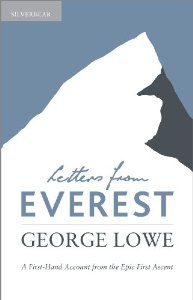
Letters from Everest - George Lowe / View from the Summit: The Remarkable Memoir by the First Person to Conquer Everest - Sir Edmund Hilary

Letters from Everest - George Lowe

Sixty years after the first ascent of Mount Everest, this unique book of letters celebrates, in a very personal way, this most majestic of mountains. With exclusive access to the private archives of pioneering New Zealand climber George Lowe, this is a welcome tribute to an unsung hero. The conquest of Everest in the summer of 1953 was one of the twentieth-century's greatest triumphs of exploration. George Lowe's exploits on the mountain would become legendary. He was one of the lead climbers, forging the route up Everest's Lhotse Face without oxygen, and later cutting steps for his partners up the summit ridge. In this touching book, a trove of unpublished letters from the Lowe collection are brought together for the first time, to describe the day-by-day moments of this historic expedition as never before. In clear and elegant prose, this is a unique testimony of a superlative human achievement.


    View from the Summit: The Remarkable Memoir by the First Person to Conquer Everest - Sir Edmund Hilary   Adventurers the world over have been inspired by the achievements of Sir Edmund Hillary, the first man ever to set foot on the summit of Mount Everest. In this candid, wry, and vastly entertaining autobiography, Hillary looks back on that 1953 landmark expedition, as well as his remarkable explorations in other exotic locales, from the South Pole to the Ganges. View From The Summit is the compelling life story of a New Zealand country boy who daydreamed of wild adventures; the pioneering climber who was knighted by Queen Elizabeth after scaling the world's tallest peak; and the elder statesman and unlikely diplomat whose groundbreaking program of aid to Nepal continues to this day, paying his debt of worldwide fame to the Himalayan region.

More than four decades after Hillary looked down from Everest's 29,000 feet, his impact is still felt -- in our fascination with the perils and triumphs of mountain climbing, and in today's phenomenon of extreme sports. The call to adventure is alive and real on every page of this gripping memoir.

Sterling stuff, indeed.  You can only stand back and gape in admiration at the man who was just utterly determined.  And along the way did so much.  He has a direct love of what he's doing.  The was no real grab for glory for him or others.  I admire that.  This book is probably still the best of a crop now available on the subject.  It's Unavoidably gripping and gives an excellent sense of the constant risk when climbing at high altitude.  It's a most marvellous life.  And at a time when New Zealand was at it's most feeble A tale of a true survivor, who not only overcame the hazards of Everest but put the fame this brought him to remarkable use.  We'll miss ya, Ed! - Right that bastard's knocked off!

From Bee Keper to World Explorer


This day in 1953, Ed and Sherpa Tenzing made history!

Sir Edmund Hillary was born in 1919 and grew up in Auckland, New Zealand. It was in New Zealand that he became interested in mountain climbing. Although he made his living as a beekeeper, he climbed mountains in New Zealand, then in the Alps, and finally in the Himalayas, where he climbed 11 different peaks of over 20,000 feet. By this time, Hillary was ready to confront the world's highest mountain.

Mt. Everest lies between Tibet and Nepal. Between 1920 and 1952, seven major expeditions had failed to reach the summit. In 1924, the famous mountaineer George Leigh-Mallory had perished in the attempt. In 1952, a team of Swiss climbers had been forced to turn back after reaching the south peak, only 1000 feet from the summit.

Edmund Hillary joined in Everest reconnaissance expeditions in 1951 and again in 1952. These exploits brought Hillary to the attention of Sir John Hunt, leader of an expedition sponsored by the Joint Himalayan Committee of the Alpine Club of Great Britain and the Royal Geographic Society to make the assault on Everest in 1953.

The expedition reached the South Peak on May, but all but two of the climbers who had come this far were forced to turn back by exhaustion at the high altitude. At last, Hillary and Tenzing Norgay, a native Nepalese climber who had participated in five previous Everest trips, were the only members of the party able to make the final assault on the summit. At 11:30 on the morning of May 29, 1953, Edmund Hillary and Tenzing Norgay reached the summit, 29,028 feet above sea level, the highest spot on earth. As remarkable as the feat of reaching the summit was the treacherous climb back down the peak.

By coincidence, the conquest of Everest was announced to the British public on the eve of the coronation of Queen Elizabeth II. The triumph of a British-led expedition combined with the inauguration of the young Queen did much to restore the confidence of a nation weary from long years of wartime hardship and postwar shortages. Edmund Hillary returned to Britain with the other climbers and was knighted by the Queen.

Now world famous, Sir Edmund Hillary turned to Antarctic exploration and led the New Zealand section of the Trans-Antarctic expedition from 1955 to 1958. In 1958 he participated in the first mechanized expedition to the South Pole. Hillary went on to organize further mountain-climbing expeditions but, as the years passed, he became more and more concerned with the welfare of the Nepalese people. In the 1960s, he returned to Nepal, to aid in the development of the society, building clinics, hospitals and 17 schools.

To facilitate these projects, two airstrips were built. These airstrips had the unforeseen consequence of bringing more tourists and would-be mountain climbers to the remote region. The Nepalese cut down ever more of their forests to provide fuel for the mountaineers. Edmund Hillary became concerned about the degradation of the environment of the Himalayas and persuaded the Nepalese government to pass laws protecting the forest and to declare the area around Everest a National Park. The Nepalese could not afford to fund this project themselves and had no experience in park management. Hillary used his great prestige to persuade the government of New Zealand to provide the necessary aid.

Immediately after the successful Everest expedition, Hillary and Sir John Hunt published their account of the expedition, The Ascent of Everest. The book was published in the U.S as The Conquest of Everest. Sir Edmund Hillary's autobiography Nothing Venture, Nothing Win was published in 1975. In 1979, he published From the Ocean to the Sky, an account of his 1977 expedition on the Ganges river from its mouth to its source in the Himalayas.

Sir Edmund's life was darkened by the loss of his wife and daughter in a plane crash in 1975. He continued to occupy himself with environmental causes and humanitarian work on the behalf of the Nepalese people for the rest of his life. He died at home in New Zealand at the age of 88, mourned by his countrymen and by legions of admirers around the world.


Friday, May 17, 2013

Athfield Architects by Julia Gatley - Auckland University Press $75.00

Anyone who’s grown up in Lower Hutt, especially around the council chambers will be familiar with Plishke’s austere, post-holocaustal modernity. The Bunker style Library, which resembles an ice cream factory or an enormous fridge; the soul-less clock towered council chambers; the stark, mater-of-fact-ness of the town hall and the Agricultural hall; even the horror of the new Dowse which mimics those other buidings or the ghettoised industrial abortion of the local police station. All these buildings scream for the ghosts of personality. Large, white and bland. Theyy shun any sense of individuality of humanity. They tell us to stay away, remain in our silos , be good little worker bees. Do not think, do not dream here in this new world of post war modernity! Listen to your government, do what they say, think what they tell you!


These are buildings that lack almost any features. Where function over form prevail.

Lower Hutt Town Hall
 The need to reject the shackles of pre war excess at the expense of clean efficient lineage simply dehumanised public and private architectural and raised it’s respect in modern day life to the clinical extreme. And that modernity was not just a product of the 40’s and 50’s – no, it remains with us today, still. I guarantee now that if you look around any home on the market you will see attempts to make clean, manila walls, new renovations are clean, lack frivolity, the lines are straight and perpendicular. In every home journal or house and garden, not a cord to be seen. There is no clutter, every surface is cleansed of human occupation. This is the legacy of all that modernity. Today houses and buildings are assets, to be cared fore but seldom to be enjoyed. Gatley’s first book, in Praise of Modern was a celebration of that tradition, which , alas is with us even in our newest works. Many of the latest buildings as simply reconfigured boxes of austerity. Domestic and corporate prisons, that whilst squeaky clean at first simply become looming and oppressive over time. Don’t believe me? Then observe the tired, bureaucratic European efficiency that is Lambton Quay’s Massey House. This is a building that needs more that a clean. It’s an geometric, algorithmic post Nazi reminder that we are all here to work to our employer’s bidding.
Massy House
There is little room for frivolity, inventiveness or creativity in the crowded real estate of the Golden Mile.

All this is why Ian Athfield was such a breath of fresh air. When his work appeared on the scene he brought the ideas of cohabitation and community from the masters such as Le Courbusier and Van Der Roe to Wellington. But unlike them, his vision was not to stack every body up like sample in a specimen cabinet. He believed in levels, surprises, twists and unpredictability. All which mixed in his work with the core requirements of the client. Athfield brought his hippy, trippy ideas into a country that was not yet able to break from the traditions of function as ‘all’. He introduced us to white buildings, as a way of adding colour to the surroundings (not teother way around). He introduced the communal living concepts of family, and proved the model in his own spiralling metropolis high above the Hutt Road in Khandallah. He Suggested adaptive re-use with first the Clyde Key Tavern and then the Broderick tavern,, which became his offices, for a while on Onslow Road. He reinvented the concept of the Council Flat in Hankey St and showed us that these dwellings didn’t necessarily need to reflect the hell hole nighmares of the English Estates. And now his thinking, in small and large projects focuses on the rebuild of Christchurch. Athfield thinks of the future heritage buildings. He asks ‘what can we build now that people may cherish in the future?’
Buck House - Designed by Athfield - Te Mata

Athfield Architects is a fabulous document of one of New Zealand’s most inventive architects. My only gripe
is that his influence has not been greater, and that too many bad buildings were constructed even after he started to get successful, perhaps those abominations will be destroyed in honour of work such as his. Gatley’s book is almost a personal admiration. As a student she was clearly involved with his projects and remains connected, as all architects do to his work. But more so, she is in a position to speak for him and articulate his thinking. In this way we can enjoy, and perhaps envy some of his achievements, as we sit in those lesser buildings, in our suburban compromise or our leaky homes, cursing our own faithlessness in a good quality design.

Julia Gatley’s a senior lecturer at the University of Auckland School of Architecture, a passionate boffin who’s penned tomes on modernism and the Group Architects in New Zealand. She also actually worked in 1987 on Athfield's bach at Awaroa Bay in the Abel Tasman National Park, so she can write from ‘proper experience’. As she says, ‘this was the most memorable’ time at architecture school, which may be why, occasionally, her tone appears still a bit gob-smacked at the ‘starchitecture’ of this humble quirky man. Mostly, the book is meticulous, scholarly but not university bookish. Real people need real architecture. And real people want to read real books about it. Don’t they? Thre is here in this investment a fantastically, preserved record of 200 Athfield Architects projects since the 60s.


She also does her best to write up his life, influences, and extraordinary times in over 300-odd footnoted pages, with a stack of high res photos and drawings. But Athfield isn't easy. The early work can be seen as counter-culture, picturesque and romantic, neo-colonial, "a mini-Islamic village of plastered pyramids and arched windows" she reminds us. In the 2000’s where does all this now site? Well if it’s lines up against some of the new work, perhaps it can be seen as a prototype, or a model for progress. As my mother would say ‘very nice, but does it leak, is it drafty, and where does the couch and telly go?” I laughed at the suggestion that the repeated use of twin chimneys could be interpreted as the "two-finger gesture to the establishment of the time". Really, I hope so. Architecture should reflect the mood of the people – not be the preserve of the filthy rich! Interestingly, and not without reason, Athfield moved from the necessary rebel to become the new establishment (in his elevation to president of the New Zealand Institute of Architects and other public roles). But as a good punk at heart we hope he still fights banality and commerce over people!


A little about the Man ....


In brief, Ian Athfield started work on his first major project, Athfield House, for his family and a studio in 1965. His early projects were constructed with a broad palette of materials including corrugated iron, plaster, stainless steel and fibre glass. As a reaction to much of the bland "Modern" architecture of the period, Athfield built in a deliberately vernacular style using features harking back to colonial buildings. His designs incorporated finials, steeply pitched roofs, timber weatherboards, verandahs and double hung windows. He was also inspired by the architecture of the Greek Islands with their exterior envelopes of continuous plaster and small windows. Conversely, he also much admired the work of Mies van der Rohe with their precise and refined detailing of industrial materials.

Athfield's sprawling metrololis over khandallah


Yet another area of influence was the geometric massing of the Japanese Metabolists. Athfield combined all these disparate elements into a highly eclectic and personal style. During the 1970s Athfield built and renovated numerous domestic houses and buildings, developing a distinctive and highly personal design approach based on the repetition of small scale elements and complex massing. Critical opposition to these 'cartoon houses' did not bother him (Manson). Another criticism of Athfield's houses were that they were built for charm and not practicality. Athfield believed, however, that “in a house, you should get a surprise every time you turn a corner and look up” (Manson).


Workers construct a concrete public toilet on the Petone foreshore in 1971 (near Hikoi koi). Concrete blocks are a popular building material due to the speed of construction. At this time concrete water pipes – used on this roof – were being used in houses as window frames by experimental architects such as Ian Athfield.

Athfield's practice expanded during the 1980s from mainly residential work to a wider variety of community and commercial buildings. As well as continuing to work on small-scale projects, his portfolio has included churches, pubs, council flats, stadiums and commercial high-rise buildings. Athfield’s best known works include Telecom Towers, Civic Square and Wellington Library, Jade Stadium in Christchurch and work on the design of the Bangkok rapid transport system.
Le Corbusier's use of Concrete
He is a past President of the New Zealand Institute of Architects, judges many design competitions and is a keynote speaker at many overseas conferences. His firm's current projects include Chews Lane Precinct, the Wellington Overseas Passenger Terminal redevelopment and the Wellington Marine Education Centre.

A documentary on Athfield, Architect of Dreams, has been produced for the NZ Documentary Festival.

Following the Canterbury earthquakes of 2010 and 2011, Athfield was appointed as an Architectural Ambassador to Christchurch.

For more information - go here: http://www.athfieldarchitects.co.nz/