Mark Henshaw published his first novel, Out of the Line of Fire, came out over 26 years ago. Since then he's done a heap of detective novels (as half
of the nome de plume J.M.Calder)
Out of the Line of Fire was the exceptional, disconcertingly smart and witty often rather beautifully lyrical murder novel. There were many others but thank goodness he's found the path back. The Snow Kimono
is again written in that edgy, off-beat manner. Henshaw roll together his retired police inspector, and two Japanese citizens - one a footless, former
law professor; the other a drunken womaniser.
The story begins in Paris, 1989 with an unwanted visitor, a Japanese
professor who knocks on the door of Inspector Jovert. Recently retired Jovert is lost, his mission gone. He's lost his was entirely in a disabling accident, he's a surrealist metaphor of the fickleness of age and ate. He's washed up but still the flannel you reach for on the bathroom floor. Familiar but contemptible.
There's time in the novel to explore Jovert's past service in Algiers, and that part of the novel is possibly the most engrossing of the book. Jovert struggles to clarify the maze of Algiers'
alleys and basements, while trying at the same time to make sense of the
moral maze into which he plunged in Algeria. This is a journey through reality, it tests loyalty in many languages. In Japan, as in Algeria,
the characters
spend a good deal of time fretting about actual sins of commission in
the past and potential sins of omission in the future. Henshaw's best line : "Memory is a savage
editor. It cuts time's throat." Memory stimulates, time is fluid, facts meld into fiction to understand reality. But what s that, anyway?
Set both in Paris and Japan, The Snow Kimono is an intricate psychological thriller but it's also a brilliant meditation
on love and loss, memory and deception, and the ties that bind us to
others. It's also highly confusing at times and often could do with some challenges in the editing. To write without compulsion is, of course, our ultimate aim. But to write and write bullshit is not. There are times when Henshaw borders on swerving into the brown stuff. It's only his own 'google' compass that helps him avoid the inevitable.
This is the follow up by highly acclaimed author Jesse Ball, who wrote of A Cure for Suicide, is back with a more singular, but still blistering novel, about a teenage girl who has lost everything—and, ultimately, will burn anything.
Ok, so Lucia's
father's died ; her mother is committed; she's living in a
garage-turned-bedroom with her aunt. Life's pretty stink. Then she gets kicked out of
school—again. Her only touch points are a book, a zippo
lighter, a pocket full of stolen licorice, a biting wit, and striking
intelligence she tries desperately to hide. She spends most of her time on the bus commuting backwards and forwards to the asylum, to
visit her mother. She has one rule to live by Don't do things you aren't proud of. So far this is the plot to The Breakfast Club, 16 Candles, Heathers, Juno and pretty much every misfit Teen film I ever got dragged to in the eighties. Then it gets a bit more interesting. Lucia discovers her new school has a secret Arson Club and she willing to do
anything to be a part of it. It's really the coming of age, belonging tale that all those movies were about - with the quirky twist and the anti- Yank high School sentiment. Think of it as the 16 Candles for the post Columbine generation. Oh, and yes, it's dark and hilarious in places. Don't take any of it seriously and you'll be fine. The plot runs a predictable course Lucia's life in the Arson Club, er, is suddenly lit up. Her need to belong is almost as strong as her need to break everything to see how they work - or rather, don't. And as her
fascination with the Arson Club grows, her story becomes one of
misguided friendship and, ultimately, destruction. Predictable, yes. Worth reading...mmmm. No.
Vincent O'Sullivan covered the topic in his play 'Shuriken' over a decade ago. The 'Featherston Incident' has become known as one of the most shameful events in New
Zealand's WWII history. Up to 600 Japanese prisoners were held there from 1943 to
the end of the war, the prisoners a mix of civilians, soldiers and sailors captured or committed under the War Act.
Hill tells the story of the mutiny of a number of Japanese officers who try to comit Hara Kiri to protect their honor after capture and instead, are slaughtered by frightened, trigger happy guards, stirred up by propaganda and nativity.
The story is narrated, in a diary format, by school boy Ewen, whose
dad works at the camp and was a a soldier in Greece. His humanitarian stance
throughout the story a surprising highlight.
Ewen's mates are Clarry and Barry Morris. Clarry suffers from polio. The boys are taught Japanese by Ito, a Japanese
officer. From him they learn all about the Japanese camp experience from their point of view - “for us to be prisoner is to be dead person”.
Add to that pressure from American troops seeking intel about Japanese troop movements in the Pacific, the fierce loyalty of the
Japanese warriors and their intense pride and hostile reactions from those who have
fought the Japanese and been tortured and you have a mixture primed for
conflict.
This is a brilliantly written book. Short, punchy. A good size for students and adults to digest. I zoomed through it on a week of train commutes. And the whole account of this tender is sensitively done. It's clear that the boys are the eyes for the reader, but they can't interfere. They are the impartial camera. A very readable novel.
Two kilometres north of the quiet little Wairarapa town of
Featherston, a small memorial garden marks the site of a riot that
resulted in the deaths of 48 Japanese prisoners of war and one guard. A
further 63 prisoners were wounded.
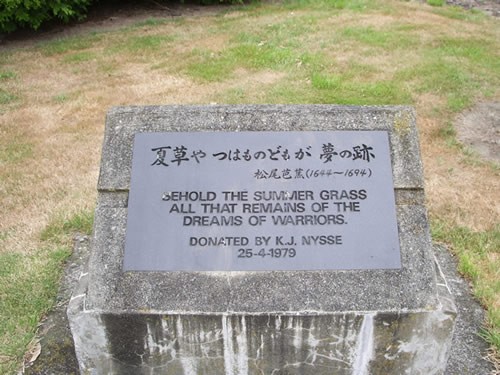
The memorial plaque
A plaque commemorates the site with a 17th-century haiku:
Behold the summer grass All that remains of the Dreams of warriors.
Featherston was the site of New Zealand's largest military training
camp during the First World War, housing 7500 men, before being
dismantled after the war. It was re-established in 1942 to house 800
Japanese prisoners of war.
The riot broke out as a result of some of the Japanese prisoners
refusing to work. Capture was humiliation enough for some of these men.
News of the riot was kept relatively quiet as a result of war-time
censorship. There were fears that the Japanese might retaliate against
Allied POWs in Japanese camps. An inquiry was quickly organised in early
March and the guards were cleared of any wrongdoing. It pointed to a
clash of cultures made worse by the language barrier. The Japanese
seemed unaware of the terms of the 1929 Prisoners of War Convention that
stated that compulsory work for POWs was permitted; the camp had only a
fragmentary translation of this available to the prisoners.
Two of the Japanese officers, Adachi and Nishimura, were found to
have stirred their fellow prisoners into action. The Imperial POW
Committee in London edited the New Zealand report to minimise any
propaganda value that the Japanese government might have gained from the
incident. The report claimed that the guards acted in self-defence when
charged by a crowd of 250 prisoners throwing rocks. It also noted that
the shooting ended as quickly as possible, lasting about 20 seconds.
Memorial garden at Featherston
Others claimed, however, that the actions at Featherston were in
retaliation for the mis-treatment of Allied POWs held in Japanese camps.
Those who defended the actions of the guards that day were quick to
point out that the Japanese prisoners had been generally well fed and
housed and that this incident was an exception to the rule. It was noted
that the Japanese were in no position to complain about one isolated
event for many Allied prisoners fared much worse in Japanese POW camps.
The Phillips curve is world
famous in 'Economy land'. Its inventor was an engineer, a genius, a man
who led a pretty exciting life and contributed to economics in many different
ways. Born and raised on a remote farm in rural New Zealand, the first
part of his life was a search for adventure. During the Depression he
worked in construction, and roamed the roads and outback of Australia
picking up casual work from gold mining to crocodile hunting. In 1937 he traveled through militarizing Japan, a guerrilla war in Manchuria,
Stalin’s Soviet Union, and growing tension in Europe. On the outbreak of
war, he joined the RAF and re-armed planes in Singapore before
incarceration in a Japanese Prisoner-of-War camp. There he learned
languages, invented gadgets, and built a clandestine radio. No longer
seeking adventure, life was now a search for economic stability.
Demobbed, Phillips scraped a sociology degree at the London School of
Economics (LSE), before convincing a skeptical faculty to let him build a
hydraulic model of the economy. This beautiful, complex machine was a
great success and Phillips was headed for serious economics.
Subsequently, he developed new ideas for stabilizing economies, began to
use electronic computers, developed the Phillips curve, showed ways to
help an economy to grow, and developed new techniques to model
economies. Always innovative, he later worked on stabilizing the Chinese
economy, wracked by the Cultural Revolution. Dr Bill Phillips pioneered a
dozen new directions in economics, making him one of the most innovative
and influential economic pioneers.
Not long before his death in 1975, the New Zealand economics
community wanted to recognize Phillips for all his achievements. So they
published a commemorative book, with chapters written by all the international economists and they presented a copy to Phillips on his birthday in November 1974. Sixty
years old and wheelchair-bound after a stroke, he carefully accepts
the book. He clearly can't move or speak very well, and is just as
clearly frustrated by this.
He listens as he's told it's a recognition of all his achievements. His
response is typically modest, and understated. He just says: "Oh, I
didn't do much. I just set off a few hares for people to chase."
For anyone who's zipped through Havelock North, you'll know that Pipi café is a welcome distraction from the surrounding vineyards and farmer's markets. Set in a Victorian style house that could well do with a lick of paint, with blankets for artworks and an overgrown English country garden out back it's shabby chic and Kiwi rustic is the main attraction - that and Tylee's also rustic but wholesome food. This is not her first book but it's probably her most useful and accessible.
With a brood of young whippersnappers herself there's a big emphasis on family food that can be produced quickly and will satisfy most palettes around the big scrubbed farm table. Potato Hash cakes, for example are not very difficult (in fact, I made them up today for brunch with only half a glance at the ingredients and method). There's an old fashioned cornbread recipe that approximates the Southern version, with courgettes for added texture. And there's a big emphasis on puddings. Jamie Oliver will love this section, with references back to the meals our gran used to make. Actually, the need to slow down and take time over a meal is inherent in many dishes here. For those of us who spent way too much time in Ohakune, there's a carrot steamed pudding, and a blueberry tart (with cream of course), and an enticing chamomile panna cotta (which I NEED to try!). The hazelnut roulade with chocolate mouse and cherries. My Granma called that chocolate rolly-polly. in fact there's an element of chic-granny in all Tylee's food. The other theme is about using what's seasonal, like fruits and veges that are only available at certain times of the year. Tylee mentions that Havelock North's abundant cornucopia of fresh is her inspiration. One imagines she has suppliers lining up with pine boxes of apples, pears, grapes, nuts and other goodies. And that's all well and good, but not all of us are so lucky. I mean, in Wellington getting hold of a cheap, plentiful supply of figs, for example is nigh on impossible!
Alexandra Tylee
What is accessible is the down to earth is her thought process. For example, she's aware that not everyone is into fancy dining so like River Cottage Hugh, she trundles down to the local hall, in this case in Poukawa, to whzz up a 'Yoga Lunch' - a good excuse to road test some mostly gluten free, sugar free food like a Kale and Red Cabbage Slaw (very yummy), a Quinoa and Smoked fish salad with tahini and coconut cream (unusual) and a roast carrot and cashew nut salad. The accompanying photos in this section suggest that the clientele to impress were not the standard ladies who lunch but the midweek blue rinse brigade. At least they'd be no complaints about the honey cheese cake if the sausage rolls and cucumber sandwiches went missing in action!
Pipi is famous for its unusual pizza toppings but there's only a couple here under the title 'Pipi Truck'. This is the cafe's side venture that gets wheeled out during event like concerts at Mission Estate. The two on offer here are so simple there's really no need for a recipe. One is a mix of roast peaches, prosciutto, rocket and fresh mozzarella. The other is Figs, blue cheese and bacon . Vegos need not apply! At the back f the book are som very cool 'Extras' such as beef bone broth, cherry tomato relish, celery salt (for seasoning) and a herbed butter called Cafe' De Paris which is awesome on steak and steamed veges like peppers and courgettes. There's also a few basic which are straight out f the Edmonds' and, I feel a bit pointless without a better description of what to expect. There's pizza dough the way Pipi makes it - which is the way I've always made it. So nothing learned here. And Flaky Pastry. Which I learned at school and now can't be arsed making, though if I did it would be like this.
Like Jamie Oliver's book, pictures tell stories about the food and the cook. There are lots of close ups of Tylee's family and a smattering of daily chores like wood chopping plus the occasional scene of her with the kids baking up a storm. On the whole, photographer Richard Brimer chose to avoid the usual 'chef and the kids' clichés because we all know that mostly the little blighters never stay in one place long enough to finish any one task s any photos that were take on them kneading dough or whisking mayo would be clearly contrived.
Overall, Pipi at Home is a book of new and old classics. There's nothing really new in it - more some affirmation and a bit of love for anyone who's a halfway decent cook wanting a book that's not too 'chef-ish' but still shappy-chic enough to make the every day and ordinary fare feel like you've just nipped down to your local café. And judging by some of the photos of half rotting sheds and un-weeded gardens with strewn blankets, scones on the patio with tea in old 'best china' porcelain, a secret excuse not to mow the lawns.
This book is a lie. A falsehood. A deceit. The brief: contributors were invited to create a comic around three words, provided by, error someone, such as 'Deep, And, Meaningful' or 'Electric, Tapir, Dreams'. Firstly, WTF is a 'Tapir' ? And how can you make on 'Dreamy electric'? What a crock. Seriously, how pretentious! Yeah, Yeah. The white middle class male reviewer doesn't understand. Why should he? He was brought up on Spider-Man and Marvel comics with all the overdrawn, exaggerated objectification of women and minor players to the outer under-pantied, bubble biceped heroes toking out on kryptonite and radioactive spider venom. Ok. Yeah, you got me. 'Love and Rockets', Jamie Fernandez, 'Tank Girl', never happened.
Truth is, graphic novels have moved on since Stan Lee ruled the universe - though he still owns a fair chunk of misogynist Hollywood - but I, as a reader still need to connect with great art and even greater writing. Much of the work in here, this book, has the sentiment, but simply falls flat because it's either too weird, too, surrealist or just threw the brief out in lieu of doing their own damn thing, regardless. One example is artist Pritika Lal who approaches her three words - Sickening, Baste, and Scoops - with a one page graphics of a woman screwing a PC with the legend 'NB: You can't imbibe anothers success by fucking them' (no comma on 'anothers'). It's a cheap, tacky throwaway with bad grammar. 20 year's ago it was punk. Now it's just crap. And there's no association to 'scoop' either. Sharon Murdoch, a political cartoonist, on the other hand, does know how to succeed on the brief. Her words: 'Scales, Kind, Prerogative' are very well explored in three pages of mini novel. Her panels explore popular media commentaries of young women (Boozy, liberal, ambitious), the glass ceiling, and the politics of sun hats. Her work is poignant and reflective. It works on all levels.
Sill in other places like Miranda Burton's exquisite dream state illustrations that rip off Robert Crumb completely, the word theme is just abandoned completely in favour of simply showcasing a significant talent. Ok, all in good. So why not just commission Burton and forget the rest. Including zine writers, artists, etc. is all wonderful but and action of democracy without direction.
Ok, so some other pages work. As a white middle class male I'm probably not the most objective reviewer. But I want intelligent, effective writing for women to get totally obsessive with. To take down the establishment and totally stick it to the male bastion. Some of this book does that. That portion is inspiring and leading. The rest is complete fish'n'chip wrapper and not worth the price. Editors should have refined their agenda and focussed more. Like modern political movements all inclusive diminishes the credibility to a cause - although what that is lost on me. It all feels like this was edited by committee, where success criteria was that you were simply invited to contribute in the first place and 'quality' was an option, not a prescription. Perhaps that's the point. Valuing art is a beholder thing, 'Quality' is a fluid idea. Or is the point that you don't need a point. Either way it's a blunt success.
Despite its queasy title, this is not a poem about illness.It’s an epic, if rambling poem chronicling Cave's 2014 tour
of North America with The Bad Seeds - an account of a 22-city
journeybegan life scribbled on airline barf bags that grew into a
restless full-length narrative epic poem that goes looking for the roots of inspiration, of love and of meaning.Coleridge woulda been proud. Cave started working on the book last year, during a flight to Nashville
Originally, it was a song, albeit a
long one but it exploded into something else entirely.There are snippets of life imagined and
real.There are a mix of stylistic name
checks – Philip Larking and WH Auden, especially.Plus deep analysis of the tour van’s
soundtrack, the tour’s soundtrack really: Elvis, John Lee Hooker, James
Brown.Plenty of roots references as
they travel through the Deep South.Oh,
and a tiny dragon makes an appearance (No, I won’t explain that one.It’s a surprise). Now 57 Cave’s got a fair
body of work under his belt.Aside from
the Birthday Party, Bad Seeds and Grinderman projects he’s also published two
novels, “And the Ass Saw the Angel,” a Southern Gothic
tragedy about a town full of religious fanatics, and “The
Death of Bunny Munro,” a dark comic novel about a sex addict who sells
beauty products door to door.Both are
gritty and challenge the reader to the extreme.
With “The Sick Bag Song,” Cave has a crack at is experimenting with a
new literary form to make a sort of jumbo of prose, poetry, song lyrics and some
elements of autobiography.His ‘poetry’ traverses the imagined child, on a railway bridge, leaping
into the muddy Mississippi – juxtaposed by the icon rock singer heading off to
the venue to become a one night deity in the eyes of fans and critics. “And I will walk onstage at Bonnaroo Festival
in Manchester, Tenn., and become an object of great fascination to almost no
one,” he said, reading from the book. “The dazed crowd will drift back and
forth across the fields and the sinking sun will flood the site with orange
fire. After the show, I will sit outside on the steps of our trailer and
smoke.”
Of course, Sharon Olds and her fellatio poems get a look in, Cave always adds a little perversion to unsettle you. It's part of the journey through the exploration of muses in famous hotels like the NY Bowery. Places where music came to writers like Cohen, without warning. In Cave's case it's Dylan that steals the muse, not the hotel. But that's another story.
It moves from childhood memories to more intimate moments from his
marriage to unvarnished behind-the-scenes episodes from the life of a rock musician.
Some will make you blush a little.Some are more about tedium, like waiting in
heavy traffic for 2 hours. Always there’s procrastination, loneliness, creativity, and more prosaic
things like throwing up on bad seafood or dying his black hair in a Milwaukee
hotel bathroom - “I carefully concoct a paste in a bowl and I paint my hair
black,/So that it sits like a sleek, inky raven’s wing/On top of my multi-story
forehead / The bathroom light is brutal./ I reposition my face so that I stop
looking/Like Kim Jong-un and start looking more like Johnny Cash/Or someone.”
His lists are some of the most intriguing moments, possibly written in the early hours of a flight, with scotch in hand and wit on fire: "The Nine Secondary Bedevilments of Creativity", The Nine Muses, "the Choruses of the Angels"....they are all reminders of Cave's extraordinary fascination with literature and the Classical world as it lives today.
His stuff has been compared to ‘the unhinged lyricism’ of Allen
Ginsberg, Walt Whitman and Mr. Berryman.I’d agree there.It’s more deft
than, say, Jim Morrison and I think should be taken seriously by those that
look down on musicians.After all,
lyrics are poetry, too.And more
accessible sometimes. As a stand alone, I don't think it would work. But removing Cave from the work would be very hard even if the reader were a Martian. It is very much a work of Cave's and a great tour diary, too.
This Paper Boat follows the author as he traces his own history through the lives and written fragments of Iris Wilkinson (aka Robin Hyde), of his parents and their parents. He explores old territories of Robin Hyde’s, still dripping with the past – the tide pool at Island Bay with its shrimp and driftwood, the garden at Laloma with its crushed lemon leaves. He listens to the stories of his parents and their parents, the eels and milk, frangipani trees, drains and barbed wire of their childhoods. He remembers a jungle of his own; he searches for ghosts in the water. While stumbling across irreparable fractures between worlds, the author uncovers the permission to have beautiful and imperfect plans.
The collection flows forwards beautifully like Ping's river, with each poem running into the next like a continuing narrative running onmany different time lines. In it there's a potted history of Kan's , as he moves back into his own past and those of his parents - travelling between Singapore and New Zealand. The poems explore early 20th century New Zealand Robin Hyde, and delve into her life at times but don't break the flow of Kan’s poetry and instead, integrate seamlessly into the writing. It's that alone that makes it all a pleasant read. "Outside the square of land you last appeared on / seventy-five years ago, I pretend to busy / my phone. I am / taking in the way Wellington had to force itself / upwards to meet you." "Walking / through
Wilton’s Bush a few days ago I was / disoriented when I cut my hand on a thorny, / overhanging branch. I realised I had no gloves. / No camouflage paint on my face, no equipment / vest, no rifle around my neck, no ammunition, / no water, no signal set, no platoon, no rank." These different pasts all reflect on the present for Kan, and even with his own past self there seems to be a certain amount of separation that is used to examine the present. Wellingtonians will totally get this, too.
These poems run every direction from emails to blog text. Modern and ancient and in that sense have a freshness at a time when poetry has a soundbite expenditure for singular event. Robyn Hide was always a literary figure I found a bit pretentious. As an academic, in my early years, I struggled to understand why she was famous or revered. Then again, I never understood McCahon either. But on face value Kan's work is intriguing and challenging. That's enough, I think.
I love MacBride. He's always on the top of my holiday reading list. Ironically, when I'm putting my feet up, avoiding the head of the midday Kiwi summer sun in a shady spot, MacBride's main character, Sergeant Logan (Lazarus) McRae is out in the worst of North Scotland's rain, sleet and snow. 'In the Cold Dark Ground' is the third book in an on-going series centred around McRae, his sometimes boss, the extremely obnoxious DCI Roberta Steel and a host of increasingly familiar side characters of constables, sergeants and DC's that crash in and out of plots that intertwine like a complicated helix of frayed DNA spaghetti strands. As each book develops, we get to meet these people as individuals and procrastinators but even more fascinating are the host of evil villains that MacBride chooses to rain upon McRae. No rest for the wicked would be the best way to describe the continuing downward spiral each book is constructed around.
This time, McRae's back in his local patch, plodding the uniformed beat when he stumbles across a missing person's case that rapidly becomes a hunt for a murder. The MP is found dead, body bleached, naked and with a bin liner tied over their head - the trademark of one particularly nastier Southern Scottish Drug lord. Inevitably, DCI Steel and her specialist crew swoop down McRae's station, 'stinking up the place', causing chaos and using up all the available cups and never doing the washing up! Within five minutes, McRae's been recruited in and expected to solve the case so Steel and her superiors can nab the glory. As the slightly disgusting, irritable but loveable rogue Steel is back on form yelling and shouting obscenities at everyone, threatening to put her size nines where the sun wont shine and generally causing more havoc than should be normal. Layer onto that McRae's unenviable looming task to shut off his girlfriend Samantha's life support system, after five years in a coma; add in some unwelcome duties to be Will Executor of the newly departed gangster Wee Hamish Mowart - which is hotly contested by Mowart's successor and McRae's nemesis, Rueben. Then add to that the circling vultures from Professional Standards, who intend to bring down Steel for inappropriate conduct. And finally, if that wasn't enough, throw in the discovery that the B-I-T-C-H from HQ who's running the MP/murder op is none other than McRae's very long lost sister and she's well 'p-d off' that McRae didn't attend their dad's recent funeral (owing to the small fact that McRae was under the impression the man had died many year's previously and was well unaware of his second family). It all builds up to a perfect Hibernian, Shakespearean mess.
As with the last two books, MacBride's ability to keep layering up complex dilemmas but still keep all Logan's balls in the air is a perfect skill. I once met MacBride, a wonderfully, mischievous crime geek, who i can well imagine secretly grinning his way through every page he writes. And fair call to. This is wonderful, dark, tragi-comedy at it's best. It's what I love about these books, they all read like wee mini series and would be perfect for TV, but the chance to totally immerse one's self in the host of characters and scenarios is really best achieved on the page, more than the screen.
MacBride has a small lexicon of his own language and terms, like 'sook': the act of sucking chip fat or biscuit chocolate off one's fingers. His irreverent passion for detailing insignificant details like how pie and pastie pastry spreads uncontrolled down one's frontage, particularly over Steels ample bosom is almost obsessive. It's a wonderful contrast to the gory details of murder victims and crime scene scenarios. These, he'll give us once before allowing each character to replay them in their own twisted words and descriptions through out the novel.
All of this, in the end amounts to yet another highly satisfying 518 pages. MacBride has a whole army of fans, who like Harry Potter and Tolkien fans have a slightly geeky fanaticism. Once you read this, you too will probably become one two. Unlike Taggart, or Morse or Midsummer Murders, this is not a simple, one dimensional British crime series - it's way better than that.
‘Kinetic art is the first new category of art since prehistory’, ex-pat New Zealand artist Len Lye boldly claimed in an essay in 1964. In Art that Moves: The Work of Len Lye, Roger Horrocks – author of a best-selling biography of Lye – explores what Lye meant by this, and how his own work in sculpture and film bore it out.
"My book is about an important artist and a big idea, Len Lye’s idea that movement could become the basis for new forms of art. . . He believed that only a few of the possibilities of movement had so far been tapped. This book aims to explore what the world of art – and the world in general – may have looked like through the eyes of an artist whose passionate interest was ‘the mystery of motion’. – Roger Horrocks
First published in 2009, this is the companion to Horrock's biography of Len Lye, 'Len Lye: A biography'. It might be compelling, but if you've read the bio, then this is ground already covered. It goes through, at an art overs' level shifts in the focus from Lye's life to his art practice and innovative aesthetic theories about "the art of motion," which continue to be relevant today, especially if you are an animator or public artist. And on that, the ownership by the public of Lye's work is something Horrocks finally gets to talk about, at least a little. in the bio, this is neglected. But here the on-going challenges of restoration, curation and even building a gallery to house his work is explored in ways that Lye, himself never contemplated. Sure Horrocks goes beyond general introductions to Lye and his artistic importance, but it's all an abridgement of the bio, and his other work 'Zizz' (which is a work from Lye's own words). Again, its thoroughly researched and fully illustrated. But the best bit is the unique set of DVDs, featuring Lye's films, kinetic sculptures, and interviews with the artist himself. Various notes on the web confirm that finding all these on youtube, etc would be a real challenge, so the chance to have them all together is worth the cover price alone. The DVD has four films where the artist painted on, or scratched into 35mm film. The celluloid is transformed into vibrant, dynamic and compelling art works, featuring stuff like the very neat "Swinging the Lambeth Walk', a dated but in tune 'Trade Tatoo' and 'Color Cry', made in America at a time when this kind of film only came from Europe. His 1958 film 'Free Radicals' makes the travel to DVD really well with the and the frenetic scratched lines still dancing chaotically through a field of dense blackness as originally intended. The film was the work of a highly wired kinetic artist responding to the music (in this case the North African Bagirmi tribe) with the sensibilities of a hip New York jazz musician and an abstract expressionist painter. There's also a great collection of shorts on some of Lye's greatest sculptures but the best bit is a short film made by Horrocks himself, produced by Shirley Horrocks, which uses Lye's quotes to walk through all his major life moments and works - the greatest introduction and the final word (or words) on the subject.
Len Lye (1901–1980) is arguably one of the twentieth century’s most original artists; a one-man art movement spanning several countries and multiple media over a lifetime and beyond. As a New Zealander practising in London during the pre-war years, and then a key figure in the post-war New York avant-garde art scene, Lye mapped a unique course through Modernism.
Roger Horrocks was Len Lye’s assistant in New York and was given the job of organising his written works. He became an expert on Lye’s life and art, and wrote an acclaimed biography that was shortlisted for the 2002 New Zealand Book Award. He has curated exhibitions of Lye’s work, directed a film about him, and written the libretto for Len Lye: The Opera.
In Zizz!(Awa Press) Horrocks tells the story in Lye’s own words, compiled from the artist’s many writings. Lye was driven by a lifelong passion for motion and energy, and how to depict them in art. This is another bite at that cherry from a more holistic view.
If you ask me, Frizzell, McCahon, Wollaston and Driver are all frauds! Completely nothing, worthless - well, in comparison to Lye, that is. It was only a few years ago, thanks to the good people of New Plymouth (some) and the arrogant bloody mindedness of the New Plymouth Council, which sparked a huge battle over the funding of a special centre for Lye's work that many of us general plebs even got to hear about this great artist. And what a man, and what a life! Horrocks should know, too. As Lye's artistic assistant, Horrocks is obviously the best person to explain the man, the artist and the visionary. Horrocks, himself is now an Emeritus Professor at Auckland University, and the founder of the Television and Media Studies Programme. He's also a filmmaker and journalist, so he's the right chap to tell the story of Len Lye. This particular story is a reprint of the original 2009 biography , with a new chapter on Lye's posthumous career, which includes the final realisation of a number of works that in the day might not have even been possible. One, the 'Water Whirler', on Wellington's Frank Kidds Park could certainly have never come to fruition until a later date, but remains a beloved landmark. Of course, the New Plymouth waterfront would not e quite complete without it's own Lye piece either.
Horrocks presents an unusual but refreshing, and it would be fair to say, extensive approach to art from the last century, navigating Lye in the process. In the short film 'Art That Moves' (made for his other book 'Art that Moves: The Work of Len Lye') Horrocks features many quotes from Lye that give you a sort of loose manifesto around his artistic philosophy and how it came to light. It's in this biography that we get the in depth details of how the artist was able to transcend the usual artist's obsessions and afflictions (loss, poverty, war, exile, alienation) and make an incredibly diverse body of work ranging from paintings to films to sculptures and writing.
His biography is inspiring and sometime jaw dropping. But the narration never sensationalises and I thought was very sympathetic. While others would choose to refrain from offering opinions or judgments, Horrocks is not afraid to add in his own asides, veiled in facts. He knew the man after all.
Layed out here, is the life and work, of probably the best example of a Kiwi made good since Katherine Mansfield. And underrated, like all Kiwi stories. It's backed by engaging research and you can really see Lye persistence through enormous adversities. Like the most efficient soldiers he seems to thrive on it. That's Horrocks showing his value in the writing. I would have liked to understand more about the 'Individual Happiness, Now' theory and a bit more critical evaluation of Lye’s films would have been valuable, too. Especially, from his peers.
Horrocks, who began his artistic journey in the 1950's, at a time when Kiwis were really starting to explore post-war European, American and South Pacific themes in their art and identity tries to every modernist theme: modernism, primitivism, expressionism, surrealism, abstract expressionism - and the future of modern sculpture. And that's where Lye’s story starts. It's that of an artist taking his vision and inspiration out of his home land to rest it in a new place in the artistic modern world. That's a world where the crossover o commercialism and art, classical music and jazz clash and collaborate. The work of Charlie Mingus, for example just goes to illustrate how music became a sort of manifesto. Today, it's music in video games and product placement in movies. Lye was sort of already doing that but making his own films set to is own composition choices.
Lye took it a step further and became an American citizen in 1950, but he was really a Kiwi at heart, despite the defection. He was born in born in New Zealand in 1901, and we learn, his early in life was marred by the death of his father, resulting in insecurity, foster homes and indifference. Now that all could have easily could have crushed or twisted young Len but instead it made him tough, and built a really self-sufficient interior life. Lye, as Horrocks tells us, and his film validates, was inspired by nature, light and especially movement. He taught himself to draw. He became interested in the processes of memory. Even in his early years, he was experimenting in some ways. He carried out a series of highly innovative systematic experiments to both strengthen his memory.
Alienated and underprepared by the New Zealand school system, Lye did what many artists do: he quit early, with minimal qualifications. He worked as a labourer, gardener, etc. But it seemed that this work only helped his thought process. The passion around movement came from his own physicality. he also studied art through books in the library but by the age of 22 Lye felt that he'd ran out of options, as an artist, here in New Zealand and relocated to Sydney, to 'join the bohemians'.it was there that Lye discovered psychoanalysis, film animation and discovered early works of kineticism.
Horrocks goes into some detail about this subject, almost to the point of obsession. But, it's important to understand this if only to understand why he moved back to New Zealand in 1924 and his interest in the tribal art of Polynesian culture, which is primal, physical and direct. Lye later travelled to Fiji, Rarotonga, Tonga and Samoa, remaining for months on end, getting to know locals, immersing himself in the culture and learning about their individual art making processes. After returning to Sydney, he finally took the plunge in 1926 to feed his restless yearning to see European modernism 'in the flesh'. So working his way to the UK as a steamship stoker, Lye headed for London. There he drew on his knowledge of Australian aboriginal and Polynesian art to get in with the artistic vanguard. He ever made images for the animated film 'Tusalava', a 9 minute long, B&W animated film about the transformation of simple life forms into complex ones that grow, evolve and are ultimately consumed. This was pretty revolutionary for its time. Very little was known about Polynesian culture, save for the racist and often inaccurate Victorian 'Cooks and Livingstone' accounts of the day. This mean Lye could establish himself in London and at some European film festivals as a credible and pioneering film artist.
'Tusalava' was supposed to be a trilogy but funding issues project meant it never progressed beyond the first picture. Still, again and again, Lye reinvestigated how to push the artistic and cinematic boundaries through batiks, paintings, writing and theory. London was good for Lye. He was accepted by the new and established artistic community; he explored associative writing and drawing techniques and he made original book covers for writers like Gertrude Stein and Robert Graves. He also published his own book of letters 'No Trouble' (1931).
An avid member of the London Film Society, Lye saw many ground-breaking European art pictures of the day but he was especially inspired by the work of Viking Eggeling, Oskar Fischinger, Hans Richter, and Walter Ruttman. Horrocks talks again in detail of their influences and reach, and how it seeps into the commercial mainstream. Lye never had the kind of money needed to make such ambitious work. So, as a man from the land of no.8 wiring, he began painting and scratching on clear film discards which he horded up from the Ealing Film Studios. Those early experiments won him a commission as a film artist by the GPO Film Unit in London.
His first GPO project was in 1935 'A Colour Box' , screened widely in local cinemas and at prestigious European film festivals. His semi-abstract movies were technically complex, bright, and above all, energetic. Music was important. you might say he was New Zealand's first music video producer! Images, patterns, colours, text were all accompanied by music like jazz or swing - a natural accompaniment. And remember, this was before Disney's Fantasia was released in 1940!
The war years were hard. He was married, but unemployed with two children. While Orwell looked to the ultimate doom of mass control, Lye was creating a new theory for a post war liberated life, which he labelled 'Individual, Happiness, Now'.
Lye did garner some work in the war years, though, working for the Realist Film Unit to make wartime information films, which led to a six month stint working on segments for the famous 'March of Time' newsreels, based in New York. Leaving his family back in England, Lye moved to New York in 1943 and was soon enamoured by the liveliness and openness of New York and decided he had to stay. But wartime travel restrictions made it impossible for Lye to move his family over. so by the time Lye’s family was able to join him in New York he'd commenced a new and serious relationship with Ann Hindle. His first marriage to Jane collapsed and he divorced and married Ann.
New York agreed with Lye. In 1953, he made the remarkable 16mm direct film 'Color Cry' which had a scorching soundtrack by blues singer Sonny Terry. It was a collage comprised of photogram strips. The method 'direct' is a cameraless means of producing photographic images, laying various fabrics and objects on the surface of unexposed colour film in a darkroom. It's highly risky as overexposure and contamination are imminent. Lye would place is objects then quickly turn on and off the room light on - therefore printing his shapes directly onto the film. All this layering is now done with computers and programmes but the three-dimensional effects he made were utterly stunning for the day - they pulsate with vibrancy and this kind of infectious, rhythmic energy. MTV would be jealous! Ironically, his works are often screened on MTV Europe during awards shows. 'Color Cry' is another film collected in the 'Art that Moves' book.
It was a technique he used to produce portraits of painter Georgia O’Keefe and poet W.H. Auden.
In 1958 Lye made 'Free Radicals', a scratch film set to a pulsing soundtrack of African drumming, for the 1958 International Experimental Film Competition in Belgium which won Second Prize. Alas it didn't translate into any further successes or commissions for Lye.
After years of living in poverty, indifferent receptions to his work and a continuous lack of project funding Lye threw in the towel. He chose to devote his energies to making 'kinetic sculptures'. His early work in the 1960s was in steel, sold through the Howard Wise Gallery in New York but exhibited in major museums across Europe and the United States. His sculptures were expensive to make, ship, exhibit and maintain so he never really made back on the sales.
Roger Horrocks
Lye’s greatest sculpture is 'Trilogy (A Flip and Two Twisters)'. These have finally returned to New Plymouth, I believe. I am looking forward to seeing them when I visit myself in March.
'Trilogy' is constructed of two nine-foot long strips of polished steel and a steel loop, suspended from overhead electric motors. When the motors are on, each piece performs this terrifying ballet like the wielding knives of a guillotine - strips of steel whip through the air at incredible speeds. Then the motors suddenly stop, and the two vertical steel strips crash to a halt with a thunderous clap! It's been likened to witnessing the opening of the gates of Heaven, or Hell.
Alas, funding was the main reason why many works never were realised. But thinking was free. So Lye became interested in genetics, and particularly DNA. He began to mine the biomorphic images from his earlier paintings and sketches as sources for a new theory called 'The Old Brain'. Lye called him self "the old brain guy who can't drive a car'.
Finally, in the late 1960's we Kiwis started to get wind of his achievements. Various dispatches from the local art community were made and finally the Lyes made it back here in 1968 to visit. He was still working when his lot his fight to leukaemia in 1980, but Kiwis are lucky that much of his work found its way back to the Govett-Brewster Art Gallery in New Plymouth, and is now in the new Len Lye Centre for all to enjoy.
I found this book engaging and almost overwhelming. It's just a shame that the story of the Govett-Brewster connection seems to be a bit lost in the process. The reason why the collection is really here instead of with Horrocks in Auckland is still an untold mystery. But that's my conspiracy. this is an excellent account and belongs in every art book collection.
Below is a list of recent reviews we some how missed publishing. So if you're looking for a few last minute gifts then consider these. Perhaps.
'According to Yes' - Dawn French
OK so our favourite vicar can write. Can't she? On the whole her books are consistently live up to expectation, and I've always enjoyed them. 'Dear Fatty', in particular had a acerbic wit that was a virtual extension of her stage presence. I just laughed my self silly. But times have changed. Serious TV appearances have dwindled. The breakup of French and Saunders, her marriage to Lenny Henry, everything has come home to roost in the years of late middle age it seems. Personally there's been a bit to much 'No' lately.
So what are we left with? According To YES. In the Foreign Land of the Very Wealthy - otherwise known as Manhattan's Upper East Side - has its own rigid code of behaviour. It's a code strictly adhered to by the Wilder-Bingham family. Yes, Virginia, rich people in fiction have Emotional displays - unacceptable. Unruly behaviour - definitely not hyphenated names. It's the rules. This is Glenn Wilder-Bingham's kingdom. A beautifully displayed impeccably edited fortress of restraint. So when Rosie Kitto, an eccentric thirty-eight-year-old primary school teacher from England, bounces in with a secret sorrow and a heart as big as the city, nobody realises that she hasn't read the rule book. For the Wilder-Bingham family, whose lives begin to unravel thread by thread, the consequences are explosive. Because after a lifetime of saying 'no', what happens when everyone starts saying . . . yes?
It seems that it takes many words to say 'Yes' - more words than she might to make a point. Add to this a range of very homogeneous characters that seem to be carbon copies from "Clueless" (Alicia Silverstone), or the film "Six Degrees of Separation" (The Donald Sutherland/Will Smith film), they all have similar issues and strangely familiar friends. There's a fair few sitcom characters, too. Plump South West women who love chocolate, for example. Not original.
There are some darkly humorous moments, a French trademark, as well as a few emotionally challenging sections to make it a bit more interesting. Yet somehow, it all feels just a little rushed and that some parts might have benefitted from more rigorous editing, Overall an enjoyable read, brilliant for a rainy day at the batch, when the Women's Weeklies run out, but don't expect to come away feeling like the ground has moved!
'Big Blue Sky - A Memoir' - Peter Garrett
Peter Garrett - Big Blue Sky
There was a time when long, bald Peter Garrett dominated our TV screens. He was a man of boundless energy, compassion, intelligence and creativity. Aussie band Midnight Oil was an outfit larger than life. Many of their songs, like "Beds Are Burning" challenged our thinking about environmental, social and indigenous rights issues. With the exception of Aboriginal musicians Yothu Yindi, nobody was as loud, as vocal or as noticed as Garrett and his boys. Yet Australian indigenous politics and climate change still remain the biggest ostriches on the farm. Australians still refuse to take these topics seriously. At least Garrett made some small in roads.
Starting at the end, with a very poetic reflection of his former Canberra Offices on the day after he's lost office as Minister for Environmental Protection, Heritage and the Arts Minister and a previous Minister for Education, Garrett begins to wind back across his own remarkable life. His first chapter is a sombre note, possibly from a man defeated by the chauvinistic bullying of the Australian parliament. Gillard has been tossed as Kevin Rudd tries to reclaim his tarnished, battered crown and Garrett, along with other Gillard cronies has been dismissed.
From his idyllic childhood in the northern suburbs of Sydney, to early work fighting for equality and social justice; to the height of 1960s culture shock at ANU and then fronting iconic Australian band Midnight Oil; and galvanising his environmental activism to become the only unaligned Cabinet Minister in two Labor governments, it's not the usual rock'n'roll journey. In fact the more you read, the more you realise that Garrett was never really just a musician. His writing is what really pulls you in. It's reflective, delicate prose, a level beyond the usual biography dirge. You can truly feel his lifelong connection to protect the environment and recognise Aboriginal people. There's also a strong colour theme, with blue being a strong player in Garrett's metaphoric pallet. Early memories of washing, kitchen paint, Sydney harbour, the ever present, endless blue sky - particularly in the desert. It colours an intense passion that stems way back before "Beds Are Burning", back to a time when no white Australian would even approach an indigenous person, let alone consider their rights. At least that's how it seemed. And there's more than one reason for bloodletting, including Garrett's demotion in the first Rudd administration, in 2010, over running a troubled Home Insulation Program, in which four labourers died. Garrett calls that chapter "The Fall Guy" - Rudd "didn't need to dump me, and you would like to think a leader with any sense of loyalty or spine, like [Paul] Keating, wouldn't have". No he's not bitter at all.
Of course the launch of the book, in Australia, was not without some further media hoo hah. Garrett, understandably dug his toes in about his "scathing description" of former Rudd, calling him "an unpredictable megalomaniac who was a threat to national security". Rudd, in response accused Garrett, of trying to "rewrite history" to sell books. However, from this side of the ditch, having watched Rudd train-crash his own party not once, but twice, I'm inclined to side with Garrett any day on this one.
'Parachuted' into the inner-Sydney ALP held seat of Kingsford Smith Garrett was not a real Labor Man. He had to fight a few stalwarts to gain credibility. Plus being a rock star would have ruffled feathers down the ASL.
At the time of the launch another black cloud - a correction Garrett was forced to make about his claim that a representative of Clubs NSW had given him "an envelope full of cash" shortly after his election. A "clarification" was inserted in Aussie versions that "Peter Garrett wishes to make clear that the envelope in fact contained a cheque, made out in favour of his electorate council, and not cash." Cheque/Cash, what ever. Given Garrett's long connection with fighting for injustice I wouldn't be surprised if this was only the tip of the iceberg.
More than a musician's memoir, Big Blue Sky contains a fair few reflections on activism, the Aussie music scene in the 60's, 70's and 80's; and a tortuous decade in politics (particularly that Rudd-Gillard-Rudd government rollercoaster) but gives little hint to what may lie ahead. I doubt that Garrett will be hanging up his megaphone for good. With the events like the Paris Climate Change Conference, Anti-Terrorism laws going through the Senate and recognition of the 'Lost Generation' (aboriginal children forced into foster care) there will be plenty of reasons to stay on the white charger. Watch this space, closely!
"Griffith Review 50 : Tall Tales Short The Novella Project III"
‘I believe the novella is the perfect form of prose fiction. It is the beautiful daughter of a rambling, bloated, ill-shaven giant (but a giant who’s a genius on his best days). And this child is the means by which many first know our greatest writers…’ Ian McEwan
Every Griffith Review is a treasure, a sort of intellectual Pandora's box that makes you look at things just a little differently. I was recently awe inspired by the vast raft of views about new Asia and new perceptions of war that the last two editions of this quarterly journal. More than anything t is truly refreshing to read thoughtful, inspiring work coming out of Australia. Being across the ditch, we are either starved of independent thoughts or drenched in middle class white Australian conservatism. But there is way more to the great red land than the internal chaos of the Labor party or what the Sydney Morning Herald thinks of the All Blacks. Best of all is the rich tapestry of fiction much that we often forget about, until we find ourselves stranded in an airport bookshop and desperate to rake past the best sellers in search of a 'real country soul'.
I'd suggest that that soul, or a tiny slice might be contained in this small volume. In 2012, the "Griffith Review 38: The Novella Project" re-launched the concept of the novella in Australia and it gave back to Australian and New Zealand authors something of a platform for this lost short:long form of fiction. Novella's are tricky things. They are more than simply long short stories. But often, they just end up being underdeveloped novels. How do you get it right?
In Aviva's introduction, she quotes David Mitchel: "I like the length of a novella ... It's short enough to be the getaway car from the cops of boredom". Who could argue with that? especially, when you keep falling asleep with the latest Elly Catton.
"Griffith Review 46: Forgotten Stories—The Novella Project II" produced another confronting, moving and provocative collection of five novellas, this time with a historical dimension.
"Griffith Review 50: Tall Tales Short—The Novella Project III" is another bite of the cherry. this time with the bar set and ready to lift even higher. It features five novellas selected from a nationwide competition, blind-judged by a panel of writers and academics: Cate Kennedy, Jacqueline Blanchard and Brian Johns. Contributors are Tony Davis, Nick Earls, Helen Gildfind, Catherine McKinnon and Madeleine Watts. There were no thematic or geographic restraints – the criteria was "were simply looking for the best work". This year the competition broke several records for the publication: we had a record number of entrants with 271 and a record number of hits – 13,000 – on the competition webpage. Our three judges considered a mountain of entries as they whittled their totals down to a handful, each choice fiercely debated. the five winners shared a prize pool of $25,000, so a time worth spending for an author, too!
Catherine McKinnon, Will Martin Nick Earls, Cargoes Madeleine Watts, Afraid of Waking It Helen Gildfind, Quarry Tony Davis, The Flight.
My favourite, if I can pick one is Nick Earls' "Cargoes", a sort of loose road story about an aging journalist taking a trip to interview a self absorbed, hard core rapper at his home. Sounds like a bit of a dream, especially for someone like me, who'd love to have been that Rolling Stone reporter drugging it up with the band in the back of the bus. If you are a fan of the TV show 'Empire' then this might seem close to home. It's the young black celebrity with a troubled past. Not entirely new I know, but Earls puts them in interesting situations, and with close camera on the intricacies of their interactions. His work definitely fits the format, though - three distinct locations and moments, with an in-depth study of each situation. A poke at each mouse in the cage. It's a very real take on the old theme of the elder statesmen surveying the precocious youth and vice versa. But definitely an original take, I thought.
Madeline Watts, in "Afraid of Waking It", tells of an impressionable young girl, our narrator, who falls under the spell of an older artist, who wants a muse - a sort of Lolita in reverse, without the pervy overtones. She's a fragile, delicate person but wields a sort of unmentioned sinister power over him that leaves you feeling confused about who's really in control. The relationship is intentionally glamorised, as if intentionally 'un-pc', to play with your own moral compass and jemmy the magnets. Moreover, the trick you learn is that no one is. That's the disturbing conclusion. The best bit, though is this incredible sense of place, like familiar photos. You get urban, suburban 'blurs', a flash out of a speeding bus, textures of a place transitioning in the seasons becoming smothering, claustrophobic, alien.
Catherine McKinnon tackles the 18th Century ("Will Martin"), with a story of a cabin boy on one of the first fleet to Botany Bay. His insights to the first contact is an interesting glimpse into the imagined minds of the early settlers, particularly Bass, Flinders et al. Definitely a good attempt this one, but of all the stories it was the most trite I thought. If this was from an aboriginal view point, then perhaps it would really seem fresh.
I'll confess I haven't read Tony Davis' "The Flight" yet. But the story of an "Edward Snowdon" type making the long hall to his trial sets up a wonderful tension and is not unlike the damaged, demented protagonist in Helen Gilfind's "Quarry", a man who tries to find love in a world that is full of anger and hate. A common theme, perhaps. Gilfind sets up a sort of 'anger management' character, and then proceeds to poke the knives. His navigation is the journey of the plot. Her 'elephant man' is the 'updatable' mutant Luke who's all too aware of his many shortcomings. This is a disturbing invitation into a world-weary, savagely damaged mind of a Frankenstein's monster in the everyday. It would all be a trashy as a 60 minutes special if not for Gildfind’s lyrical approach which settles us into the rhythms of Luke's thinking and familiarises us sufficiently to become sympathetic to his plight.
These are challenging and abrasive stories at times. Sometimes the themes are familiar, sometimes a little unrecognisable in their form. Sometimes the voices are not as unique as one would like. But always challenging, so that alone is a good reason to pack this one away for the quietest times - for reading just for your self.
Good Bye Pork Pie is still one of the greatest movies ever made - There I said it. And not just because Bill Gruar's (no relation) daughter Shirley was in it. It was the first on screen breast I ever saw or a willy or and the first time tomato sauce was splattered on fried eggs or the first time a mini was destroyed on screen on the road! It was awesome - and still is.
Murphy’s memoir should be as popular as his three hit movies of the 1980s. He just keeps proving himself a natural story weaver, and in this entertaining account he tells his own story with a very droll humour. Often as not it's a self-deprecating rendition, with occasional unforgiving moments. Especially when it comes to his own foibles.
He talks fondly about early life in the Capital. Almost compulsary for an artist of the 60's was the Catholic Education. Of course Murphy was strapped during his primary school years at Marist Thorndon, nay caned during his secondary school at St Patrick’s Town and like my dad he did the compulsory military training at 18 - “Conscripts were marched endlessly, up and down the parade ground with NCOs shouting at us at the top of their voices.” there was an awakening at Victoria University, especially when he became a trumpet player in the uni jazz band. Then the setting sun of drudgery beckoned with a move to teachers’ college. A complete failure to teaching and a gain for film, in the long run, he was given the lowest marks during seven years as a primary teacher. Finding other ways of earning money he ended up touring with Blerta (the Bruno Lawrence Electric Revelation and Travelling Apparition.)
The idea filmmaking surfaced in the dismal teaching days. “If you wanted to make films [in the early days] you had to be tenacious, persevering, devious and lucky”... because the "absolutely absurd structure” of the local film industry in the 1960s" made it nearly impossible. “Two main producers: television and the National Film Unit, both lavishly government funded.” The Film Unit was “anointed with the sole right to make motion pictures in New Zealand. Anyone else attempting to enter this field was an upstart and should be opposed rigorously.” Of course, in the centre were the independents and freelancers, led by John O’Shea’s Pacific Films, whose film processing had to be done in Australia because the Film Unit refused to handle anyone’s images except their own. It was a time of Muldoonism on the rise, unions and Bloodymindedness. “How were we going to succeed in this atmosphere?” says Murphy. He answer his own question with many tall tales of extraordinary initiatives, including building and spec building a new camera crane, which was then hired by everyone including television and even the Film Unit. And even funnier - setting up the legendary Acme Sausage Company. “It was suggested that it should be a functioning anarchy. [But] the likes of Andy Grant and Albol had no need of philosophical principles. As far as they were concerned, you just set your goals and went for them. In the end, the devastatingly simplicity of this philosophy, or lack of it, was its strength, and ultimately we all took it up. Interestingly enough, this is pretty much what the main characters in Goodbye Pork Pie did when we got around to making that film some ten years later.”
If you're a film buff, you'll probably pooh pooh it a bit but Geoff’s descriptions of the challenges involved in making Pork Pie, Utu and The Quiet Earth are absolutely eye-openingly entertainment. Brilliant as just a great account of good ol Kiwi Fuck-it-let's-do-it!
He’s frank about his personal life, marrying Pat, raising five children. And after 15 years, beginning a relationship of “intensity and passion” with Diane, but not leaving Pat. (“There were the kids, there was my own emotional cowardice, and then there was that thing called Catholic conditioning.”) The complexities of a shared life in the commune at Waimarama, which would lead to fisticuffs of law in court. The final separation from Pat, after 22 years and the abandonment of the relationship with Diane and a new relationship with Merata Mita who “was sometimes economical with the truth”. And then, after 20 years, a new relationship with Diane, who he finally married.
And there's a few star turns Dinner with Jagger and a holiday in the Jagger residence in Mustique. Directing Emelio Estevez, Anthony Hopkins, Stephen Seagal and 'almost' directing Arnold Schwarzenegger. Hanging out in Beverly Hills with Russell Crowe. And, almost as famously directing second unit for Peter Jackson on The Lord of the Rings. (Five camera crews in Twizel, and 200 people under his command, as well as 300 soldiers on horseback and 150 orcs in rubber suits.)
And It goes on. It's a book I look to every night for another instalment - I couldn't put it down or should I - Like a good movie, with a much bigger cast and a much more substantial plot - and about 10 sequels!
'All the singlllllla Laaaaadies! Buy these books up!' What does it take for someone from humble beginnings to become one of the most powerful artists in the world?
Beyonce Giselle Knowles knew who, and what, she wanted to be since the age of 8. Even then, she had extraordinary talent, drive, and ambition. But it takes more than just that to become a star. This is the story of the long road traveled by a talent show prodigy, and the parents who sacrificed everything for her, as she evolved from a pageant show winner and girl group singer into the vocalist, actress, pop icon, wife and mother she is today. It is also the story of a darker side that is, unfortunately, the price of success: in the remaking of an everyday girl into a global superstar, something, or someone, can get lost. The path to becoming “Beyonce” would ultimately be defined by a choice: to let go of the past and embrace her own future — not the one she thought she was destined to have, but the one she would now create for herself.
Beyoncé has sold more than 250 million records, both as a member of Destiny’s Child and as a solo artist, and has become one of the most powerful and popular musical acts in history. Yet despite years of high visibility, the woman behind the carefully tailored brand has remained a mystery to the media and her fans—until now.
As the first comprehensive biography of Beyonce Knowles, BECOMING BEYONCE not only includes countless revelations about her guarded, personal life with Jay Z, it documents all of her many record-breaking career milestones, including behind-the-scenes stories of her hit recordings as told to J. Randy Taraborrelli by writers and producers never before interviewed. Indeed, in crafting this portrait, acclaimed celebrity biographer J. Randy Taraborrelli conducted exhaustive research and interviewed scores of Beyonce’s intimates.
BECOMING BEYONCÉ is a backstage pass to the glamorous and cutthroat world of the music business, and an absorbing insider account of the birth of a pop culture legend.
'For a lot of years, I've answered a lot of questions, but have never told my story before', says the original panty magnet. For over 60 years Sir Tom Jones has maintained a vital career in a risky, fickle, unstable music business - a business notorious for the short lives of its artists. With a drive that comes from nothing but the love for what he does, he breaks through and then wrestles with the vagaries of the music industry, the nature of success and its inevitable consequences. Having recorded an expansive body of work and performed with fellow artists from across the spectrum and across every popular music genre, from rock, pop and dance to country, blues and soul, the one constant throughout has been his unique musical gifts and unmistakable voice. But how did a boyo from a Welsh coal-mining family attain success across the globe? And how has he survived the twists and turns of fame and fortune to not only stay exciting, but actually become more credible and interesting with age? In this, his first ever autobiography, Tom revisits his past and tells the tale of his journey from wartime Pontypridd to LA and beyond. He reveals the stories behind the ups and downs of his fascinating and remarkable life, from the early heydays to the subsequent fallow years to his later period of artistic renaissance. It's the story nobody else knows or understands, told by the man who lived it, and written the only way he knows how: simply and from the heart. Raw, honest, funny and powerful, this is a memoir like no other from one of the world's greatest ever singing talents. This is Tom Jones and Over the Top and Back is his story.
Now, beyond 'Delilah' I never really fancied him as an artist but mum always played his cassettes while I was growing up. The voice on that man! Then, I spot this. It's a no-brainer. I've got to read it. And I gotta say, it's a great read. I like that it's not a 'beginning-middle-end'. Not just full of stories worth telling in order, year to year. Sure we have the 'I was born, grew up, etc' but the narrative bounces around enough to be interesting, compelling. It feels like I'm sitting with him of an evening and he's remembering times gone by and recounting memories as they come to him: happenings; feelings; encounters. Although there is of course a good structure to this but the change in scenes holds my attention and insists I read the next chapter straight away. Good imagery and sense of atmosphere. Well written even if it wasn't Sir Tom's actual handwriting. Enough twists and turns and also turning out to be a really good, interesting life story. Shows his humility and honesty. Some swear words, just in case you're easily offended, which I'm not but I do appreciate that intimate descriptions are suggested rather than explained. Like when Sir Tom tells of his 'first time' with Linda. We don't need to 'know'... he gets that. His use of the 'f' word is always in the right place. Tears and laughter in one thoroughly fab night of the first 13 chapters with Sir Tom and his own story. I hear 'I've gotta be me' on every page and I can't wait until bedtime tonight to start where I left off. Not been so captivated by a book in years. Loving reading his story and thoroughly recommend it to anyone with even a little interest in the man.
Ever since first pottering around the UK compiling his eye opening humorous account, Notes from A Small Island, this unashamedly Anglophilic Limey has endeared himself to the National Trust subbies and Badger huggers of Britain. Clearly charmed by his obvious fondness for their nutty, eccentric ways and his ,eye for a good poke he was able to distance himself just enough to gently laugh at and with the a country that could never do it to themselves. Owning a tweed jacket and a fond turn of phrase was definitely a way to transverse a Bryson a country that most of us still find bewildering, quirky, endearing and beautiful at times. And, it certainly is very easy to laugh at some of their ridiculous place names and customs.
Notes from a Small Island. it turns out, was the best-selling British travel book ever (as voted in a BBC poll), It was “the book that best represents Britain”. So, of course, a follow-up was inevitable – albeit 20 years later. On the cover of his new one, The Road to Little Dribbling: More Notes from A Small Island, there’s a colourful drawing of the white cliffs of the Seven Sisters, and the jolly John Bull-type fisherman from the 50’s Skegness seaside postcards. It’s a reference to Bryson’s own nostalgic mood as he takes off from the South Coast to make a long walk the length of the island, following a direct line from Bognor Regis to Cape Wrath, Scotland’s furthest tip. This line, if you run a ruler over the UK map is the longest ‘undisturbed’ line from the most southern to the most northern townships. The Bryson line. If Paul Thoreau is acerbic then Bryson is the opposite, if more cummudgingly. I’m not entirely sure if this is really a re-visit of his own reasons for trying to become a Pom or a reason to write a bit a an ageist grumble.
Bryson loves the Cotswold’s, etc. – the picture book Britain. It’s a real challenge to create this world. He grumbles at the decaying of the greengrocers, the postcard villages, and Torquay beach pier. Kiwis, who’ve been to Britain, bought their argyle sweaters and still wear them wil love this. It’s a very good whine at how the world is falling apart. He grumbles at anyone under 30, accusing them all as idiots and half wits. He hates food courts and bemoans the loss of grocery shops.
It’s no surprise that he starts off a Bognor Regis, in view of George V’s sharp assessment of the town, when he paid a visit to the place to benefit from its sea air. Upon returning to London, George, apparently refreshed, soon fell ill again – probably from coal smoke pollution and bad water. When his doctor suggested he once more should visit the seaside, the King tartly replied, “Bugger Bognor!”, and passed away.
When Bryson arrived on Britain’s shore, he says he found a country that was wholly strange, yet somehow marvellous, a feeling that has never left him. Yet, he’s now living in a country that he doesn’t recognize – a not-uncommon complaint of all of us moving inexorably toward the twilight of our years. He decides to become a fully fledged Brit, this man from the US Mid West. Bryson loves to talk about his UK Passport exam where he was required to pass a series of exams for which there were helpful “study guides “to aid the hapless alien. One example of the questions will suffice:
Manchester United is:
(a) a political party,
(b) a dance band,
(c) an English football team.
He passed, receiving certification as a intellectually fit for life in modern Britain.
Bryson has always been an advocate of nature and its preservation and he dearly loves the countryside he rambles through, bemoaning the disappearance of hedgerows, wild flowers, sheep roaming over fells, churches, barns, even village shops, swept aside on economic grounds. And he’s certainly not a fan of Britain’s National Trust, after some chunky sweater refused to let him take a photo of an old lighthouse.
The observation, the wit, the geniality of Bryson’s inimitable words illuminate every chapter. Our hero finds himself crossing a field with a friend, who mentioned that there was a bull about 50 feet away. After he and his friend had run to the safety of the other side of the fence, Bryson petulantly inquired why a bull is allowed in a field with a footpath. His complaint was dismissed: “The real danger is cows. Cows kill a lot more people than bulls.” Bryson pursues the fact that cow-trampling is rare enough, but always reported in British papers, and completely ignored in the States, where death by shooting takes precedence. He claims that if he asked a British friend about their chances of being attacked by a cow, the friend would be aware of the danger. An American would reply, “Why would I be in a field with cows?”
Bryson loves London. Not just for its green spaces, its history, its diversity, its startling new skyline, its museums and galleries, but its Underground, of all things. Thank heaven he drew the line at its buses and endless road works. At the pinnacle of the great metropolis is Boris Johnson, “a man whose bumbling manner, whose very hair, is a monument to disorder. And somehow, it works.”
Now I'm not entirely sure that this new view of Britain through Bryson’s now more rheumy lens is really going to meet with the same overwhelming wave of approval that greeted his Small Island but... The Brits are a phlegmatic people, stiff upper and all that, brushing off criticism confidently and easily, but there will be exception taken to the author’s scornful dismissal of such precious gems as Eastleigh, Bournemouth and Lyme Regis, although he was enraptured by Widecome-in-the-Moor. And then, there was Salcombe, fashionable gem in the diadem of Devon. Bit too smart and jaunty for Big Bill’s liking. In the deli there, he ordered Brie and asparagus tart, made with organic cider, which infuriated him.
Apparently, British food had gone from strange and unappetising full circle to strange and unappetising again – he wants a return to fish-and-chips, prawn cocktail and Black Forest gateau. Did Gordon Ramsay, Jamie Oliver and Master Chef not exist? What mirage happened? Or was that only a TV fantasy? While you’re there, Bill has taken a violent dislike to the country’s bus shelters, the slow disappearance of the London black cab, policemen dressed in yellow vests that make them look like railway workers. And, what happened to policemen’s helmets?
Nobody around here is going to take particularly kindly, either, to Bryson’s ranting that people everywhere have abandoned whole elements of grammatical English, and correct punctuation is a thing of the past. He even has the nerve to drag the revered Sam Cam, wife of the prime minister, into it. She is reported as saying, “Me and the kids help to keep him grounded.”
The great road trip takes a fairly straight line from the blessed Bognor straight through Oxford with diversions to Cambridge and Norfolk, past Blenheim, Birmingham, deviating again to “bracing” (cold,windy) Skegness, where the little fisherman on the front cover hails from, and where that great British institution, the holiday camp, first blared out its welcome to happy campers.
It seems that Bill has grown a little tetchy with the passing years, a good man’s fault, but his altercations with barmen, Big Mac vendors and his outrage at a middle-class woman’s tiny tip to a waiter seem unworthy.
Anyway, onwards and upwards, swiftly past Liverpool, on through Manchester, the Peak District, Lancashire and the glories of Blackpool, the great Tower, the sparkling new Promenade. When Bryson first came there, 20 million happy holidaymakers visited Blackpool every year. Now, according to our guide, it’s depressed and derelict. Bryson wants a return to the old tradition of the seaside shows, and an end to the drunken violence. Who could argue?
The Lake District is beyond criticism and Bryson has a soft spot for Yorkshire, where “they speak as they find”. Although my own favourite Yorkshireism is “I’m only rude to people I like”.
Finally on, after 700 miles, to Cape Wrath, which involves a train journey, a car journey, a ferry ride and a minibus through an uncharted wilderness. And if you miss the last autumn ferry, you have to wait until the following spring.
At Cape Wrath, the long and weary trail no longer winding, Bill Bryson looks north to the polar ice-cap and reflects, with pardonable pride, that, for a few precious moments, he was “the most northwesterly person in Britain”.
There’s a list of the things he likes best about Britain, that includes cream teas, jam roly-poly with custard, country pubs, the shipping forecast and villages with names like Shellow Bowells and Nether Wallop. All wonderful, but must have missed Little Dribbling . . .