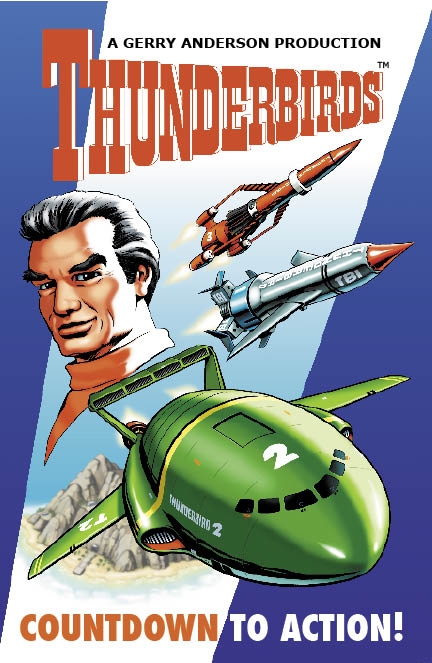
The classic British sci-fi series “Thunderbirds” will receive a high-tech reboot at the hands of New Zealand’s Oscar-winning Weta Workshop, it was announced on Tuesday (5/2/2013). The special effects company, which has worked on movies such as “The Lord of the Rings” and “Avatar”, said Britain’s ITV had commissioned 26 episodes of the 1960s hit show, created by the late Gerry Anderson (left). The series, with the working title “Thunderbirds are Go!”, is scheduled to screen in Britain in 2015, 50 years after the original debuted. Weta chief Richard Taylor said he was looking forward to introducing a new generation to the show, which depicts an international rescue organisation that thwarts evil-doers with spacecraft launched from its secret base. “Thunderbirds was a hugely influential television series in my childhood,” said Taylor, whose Wellington-based Pukeko Pictures will co-produce the new series. While the original used a form of puppetry dubbed “Supermarionation” to bring characters such as Brains and Lady Penelope to life, the new version will combine live action and computer generated imagery.
All about Thunderbirds (everything!)
The Thunderbirds TV series is set in the 21st century, which at the time of production was still over thirty years away. Co-creator Anderson said for the series to be set "100 years in the future," indicating a date of 2065, despite varying years showing up on various objects throughout the series. This intent was carried forward in all of the series' contemporary tie-in merchandise, such as the weekly comic strip in TV Century 21 and the Century 21 Mini-Album "Thunderbird 3", wherein Alan Tracy tells listeners that the year is 2065. 1993 vintage champagne is discussed in "Alias Mr. Hackenbacker". The feature film Thunderbirds Are Go is shown to take place in June 2066, and in Thunderbird 6 it is June 2068. In addition, the Zero X spacecraft from Thunderbirds Are Go subsequently appeared in the opening episode of Anderson's next TV series, Captain Scarlet and the Mysterons, which was set in 2068.

The show depicts the adventures of the Tracy family, which consists of millionaire former astronaut Jeff Tracy (one of the first men to land on the moon) and his five sons: Scott (pilot of Thunderbird 1 and principal rescue co-ordinator), Virgil (pilot of Thunderbird 2), Alan (astronaut in Thunderbird 3), Gordon (aquanaut in Thunderbird 4) and John (principal duty astronaut on the space station Thunderbird 5) – each named after a Mercury astronaut – Scott Carpenter, Virgil Grissom, Alan Shepard, Gordon Cooper and John Glenn, respectively. Together with Jeff's elderly mother called Grandma Tracy, the scientific genius and engineer "Brains", the family's manservant Kyrano and his daughter Tin-Tin, the Tracy family live on a remote, uncharted island.
International Rescue's London agent, international socialite Lady Penelope Creighton-Ward, and her Cockney butler/chauffeur Aloysius "Nosey" Parker, are often seen chasing The Hood and other villains in the pink, amphibious Rolls-Royce FAB1, which is equipped with James Bond-style gadgets. (Rolls-Royce actually provided an authentic radiator grille to the production company for closeups of FAB-1, such as when the retractable machine gun was fired.) Lady Penelope's yacht is called FAB-2. Although credited as "London-based Agent", Lady Penelope lives in a mansion in Kent, which is actually a miniature copy of real-life Stourhead House in Wiltshire.

Some of the disasters attended by International Rescue are often the result of accident or misadventure, but on occasion involve deliberate sabotage. A recurring villain, "The Hood" (actually never named in the dialogue, but referred to as such in narration, in the comics, tie-in books and other spin-off media), frequently causes major accidents in order to lure International Rescue's vehicles to the scene and spy on or steal them. Although never credited as such, two characters would have recurring roles in the series, with London Airport controller Commander Norman appearing five times. Fireflash pilot Captain Hanson would appear five times as well, though three of his appearances were part of reused or archive footage.
The main characters' appearances were modelled after prominent actors. Jeff Tracy was modelled after Lorne Greene of Bonanza fame, Alan after Robert Reed, Scott after Sean Connery, and John after both Adam Faith and Charlton Heston.

The Thunderbirds' radio code "F-A-B", meaning "message received and understood", did not stand for anything, it was just supposed to sound "hip". In fact, when asked what it stood for, Gerry Anderson once replied, with some bemusement, "Fab", as though it were obvious. Later, due in part to fan-submitted stories, F-A-B came to mean Fully Advised and Briefed, in keeping with P-W-O-R (Proceeding With Orders Received), a similar radio confirm code in the Stingray series.
UniformAll the Thunderbird pilots wear a common mid-blue uniform consisting of a polo-neck tunic, trousers, boots, and a simplified side cap. The uniform is accented by a sash bearing the International Rescue insignia and holding a sidearm and two pouches. Each pilot's sash is a different colour, and they have matching coloured cuffs to their boots:
Scott – Light Blue
Virgil – Canary Yellow
Alan – White
Gordon – Orange
John – Lilac
Occasionally other members of the organisation are shown in similar uniforms:
 |
| Brains |
Brains – with a brown, leather-like sash, seen only when he flies the Tiger Moth biplane in the 1968 film Thunderbird 6.
 |
| Jeff Tracy |
Jeff – a metallic gold sash, carrying the logo badge for the Dr. Barnardo's children's charity. Never actually seen in the series, this was used in publicity for the film Thunderbirds are Go (1966), and later reproduced in books and the DVD boxset.
 |
| Tin Tin |
Tin-Tin - for her single designated rescue mission aboard Thunderbird 3 in the episode "Sun Probe", and briefly in "The Uninvited", she wore a similar blue uniform with a pale blue belt but no sash.
MachinesMain article: Thunderbirds machines
Each episode featured model vehicles and machines primarily designed by special effects director Derek Meddings; in particular, the five Thunderbird craft:
Thunderbird 1 – Hypersonic variable-sweep wing rocket plane used for fast response, rescue zone reconnaissance, and as a mobile control base.
Thunderbird 2 – Heavy supersonic VTOL carrier lifting body aircraft used for the transport of major rescue equipment and vehicles, including Thunderbird 4.
Thunderbird 3 – Re-usable, vertically-launched SSTO (Single-stage-to-orbit) spacecraft used for space rescue and maintenance of Thunderbird 5.
Thunderbird 4 – Small utility submersible for underwater rescue.
Thunderbird 5 – Space station in geostationary Earth orbit monitoring broadcasts around the globe for transmissions calling for help; also manages communications within International Rescue.
Production - Conception
Commissioned by Lew Grade of ITC Entertainment, Thunderbirds was the fourth Supermarionation children's series to be made by AP Films. The logo of Supermarionation had previously introduced episodes of Supercar (1960–61), Fireball XL5 (1961–62), and Stingray (1962–63). Gerry Anderson's inspiration for the underlying concept of Thunderbirds was the West German mining disaster that later came to be known as the Wunder von Lengede ("The Miracle of Lengede") – on 24 October 1963, the collapse of a nearby dam left the iron mine at Lengede, Lower Saxony, flooded and 50 men trapped underground; by 7 November, 21 had been rescued. The heavy equipment required to rescue the miners was located far from the mine itself, and the time needed for transport proved to be a major hindrance in ensuring the survival of the men.
Hoping to distinguish this idea from the premises of the first four puppet TV series he had produced, with plots that would appeal as much to adults as to children and an early-evening transmission slot, Anderson retired with his wife Sylvia to their holiday villa in Portugal to develop the premise and script the pilot episode. The title Thunderbirds derived from a letter posted by Anderson's deceased older brother, Lionel, while he was serving as an Royal Air Force pilot based in Arizona during the Second World War. In his letter, Lionel had made reference to a nearby United States Air Force base, Thunderbird Field. The working title had been "International Rescue"; drawn in by the "punchiness" of "Thunderbirds", Anderson elected not only to rename the series but also the fleet of rescue vehicles, which had originally been designated Rescue One, Two, Three, Four and Five.
Many members of the Thunderbirds crew had contributed to its direct antecedent, Stingray. For Thunderbirds, the production team was expanded, and the series was shot at APF's Stirling Road studio on the Slough Trading Estate. Production commenced in September 1964 and the series premiered on UK television on 30 September 1965 in the ATV Midlands region. Other ITV regions followed, ATV London commencing broadcasts on 25 December 1965. Two series were produced, comprising 32 episodes with a running time of 50 minutes. Each episode was also split into two parts for a half-hour slot, creating 64 episodes of 25 minutes' duration.
Thunderbirds was the first one-hour series to be produced by APF. A few months into production, Grade viewed the completed pilot episode, "Trapped in the Sky", at a private screening and was so pleased with the result that he instructed Anderson to double the length of the episodes from 25 minutes to 50 minutes. This initially proved to be a headache as eight episodes had already been filmed and scripts for 10 more had been written.
Voice cast
In developing the cast of characters that would appear in Thunderbirds, the first consideration of the Andersons, Reg Hill and John Read was the series' potential for transatlantic appeal.[13] As such, while the Tracy family destined to operate the Thunderbird machines would be American, the International Rescue organisation would depend on its British field agents Lady Penelope and Parker for the purposes of intelligence.
David Holliday (the voice of
Virgil in the first 26 episodes) was the only American to be cast for a voice role in Thunderbirds, the remaining members of the voice cast being British, Australian or Canadian.
Australian actor Ray Barrett provided the voices of
John Tracy, operator of Thunderbird 5, and The Hood, the arch-enemy of International Rescue, in addition to many supporting roles. He had worked for Anderson before, voicing both Commander Shore and Titan for Stingray. Drawing on the experience gained from radio work in Australia, Barrett was adept at performing a variety of voices in quick succession and could also perform both British and American accents convincingly. Although Sylvia Anderson or Christine Finn, the voices of Lady Penelope and Tin-Tin Kyrano, usually took responsibility for voicing female one-off characters, Barrett made an exception when, to the hilarity of his fellow cast members, he voiced the elderly Duchess of Royston in the episode "The Duchess Assignment".
Canadian actor Shane Rimmer (
Scott Tracy) went on to appear in – and on occasion write scripts for – later Anderson productions. David Graham, one of Anderson's longest-serving voice actors, had previously worked on Four Feather Falls, Supercar, Fireball XL5 and Stingray and was also one of the original voices of the Daleks in Doctor Who in 1963. Graham supplied no fewer than four of the main characters' voices – Gordon Tracy, Parker, International Rescue's resident scientist, Brains, and Tin-Tin's father, Kyrano.
Voice cast
Peter Dyneley as Jeff Tracy, Commander Norman and various supporting characters
Shane Rimmer as Scott Tracy and various supporting characters
Ray Barrett as John Tracy, Alan Tracy (in one episode only, "Trapped in the Sky"), The Hood and various supporting characters
David Holliday as Virgil Tracy (Series One) and various supporting characters
Jeremy Wilkin as Virgil Tracy (Series Two, Thunderbirds Are Go and Thunderbird 6) and various supporting characters
David Graham as Gordon Tracy, Brains, Parker, Kyrano, Captain Hansen and various supporting characters
Matt Zimmerman as Alan Tracy and various supporting characters
Sylvia Anderson as Lady Penelope Creighton-Ward and various supporting characters
Christine Finn as Tin-Tin Kyrano, Grandma Tracy and various supporting characters
Paul Maxwell as various supporting characters (Series Two)
John Tate as various supporting characters (Series Two)
Charles Tingwell as various supporting characters (Series Two)
Maxwell (the voice of Zodiac in Fireball XL5), "Bud" Tingwell and Tate received no on-screen credit in either series, although Maxwell and Tingwell were credited for the films Thunderbirds Are Go (1966) and Thunderbird 6 (1968). Thunderbirds Are Go also featured two early voice contributions by entertainer Bob Monkhouse.
It has also long been rumoured that the opening "5 4 3 2 1 Thunderbirds Are Go!" voiceover was provided by Brian Cobby in 1965, who went on for many years to be the voice of the British speaking clock. While Cobby himself long maintained this and said he had even received repeat-fee royalties from the BBC, the assertion is rejected by the surviving members of the cast and by Gerry Anderson, all of whom are adamant that the voice is that of Peter Dyneley in character as Jeff Tracy. The general consensus is that Cobby provided the voice for a Thunderbird 2 talking alarm clock produced in the early 1990s and had a clouded recollection of events, but the rumour remains in general circulation.
Design and effects
The special effects supervisor for all Anderson's productions from Supercar to UFO was Derek Meddings, who went on to produce effects for the James Bond and Superman film series. For Thunderbirds, Meddings also found himself with the task of designing the primary vehicles after it was decided that former head designer Reg Hill would serve only as associate producer.
Scale models for a number of the Thunderbird machines were constructed by a professional model-making company, Master Models of Middlesex, while others were custom-made by Meddings and his team from commercially-available radio-controlled vehicle building kits.eddings was not satisfied with the concept of Thunderbird 2, which was originally to be blue in colour as opposed to green, until he inverted the aircraft's wings. The job of sculpting the largest scale model of International Rescue's heavy-duty transporter in balsa wood fell to Arthur "Wag" Evans of Master Models. Thunderbird 3, whose appearance was based on that of the Russian Soyuz rocket, was realised as a model that stood six feet (2 m) tall, although ultimately the largest model to be built for filming proved to be FAB 1, whose miniature needed to be big enough to fit the two-foot (0.6 m) marionette puppets of Lady Penelope and Parker. Seven feet (2.1 m) in length, the large-scale plywood FAB 1 model cost £2,500 to build in 1964; post-decimalisation, this is equivalent to £30,000.
One of the latest additions to the effects department for the production of Thunderbirds was Mike Trim, who became Medding's assistant in designing the vehicles and buildings that populate the world of Thunderbirds. The existing staff, managed by effects director Brian Johncock, was further expanded by the arrival of Roger Dicken, who had previously worked for the BBC Visual Effects Department. Meddings and Trim pioneered the technique of "customising" models and sets by applying pieces drawn from commercial model kits to add convincing surface detail. For example, the air-conditioning silos visible on either side of Thunderbird 1 in its underground hangar were originally 1960s periscope toys manufactured by J & L Randall. The Thunderbirds miniatures were also "aged" with paint and dust to give an impression of work-weary vehicles. These techniques became standard practice in the special effects industry and were put to use in the building of the miniature spacecraft and other vehicles for the films of the original Star Wars trilogy (1977–83).
One of Meddings' design innovations for Thunderbirds was a cyclical, moving effects stage (termed the "rolling road" or "rolling sky") to be used for sequences depicting aircraft flight, take-off and landing, as well as motor vehicles being driven along roads. Judging that the established method – pushing or pulling scale models across a static base or against a static background – no longer provided a satisfactory illusion of movement, Meddings came up with a new solution of his own that was first deployed during production on the pilot episode, in which International Rescue's remotely-operated Elevator Cars speed down a runway to assist in the controlled landing of the aircraft Fireflash. Meddings constructed a belt of canvas, stretched over rollers and driven by an electric motor. With the help of wires, the miniature Elevator Car models remained stationary on the "rolling road" and the Fireflash model was lowered onto the stage from overhead, simulating the aircraft's descent. Another system of rollers, this one painted to represent a sky background, was erected perpendicular to the canvas belt, and both roller motors were synchronised so that the speeds of the two design elements were matched. This process simplified the work of the camera and lighting effects teams, since the models did not move and sequences were easier to film and light. For shots of airborne aircraft, the illusion was enhanced by blowing smoke across the sets from a fan to simulate passing clouds, and by connecting the canvas belt at an angle to hide what would otherwise have been a visible seam. The "rolling road" system would later feature in the effects of a number of James Bond films.
Miniature explosions seen in the series required materials such as petroleum and fuller's earth. Originally filmed at high speed, the sequences were slowed to normal speed during episode post-production to achieve more persuasive results. For higher-quality rocket take-offs and landings, the effects department commissioned a UK firm to supply thrustless, solid-fuelled rocket canisters, in a range of sizes, that would burn for approximately 10 seconds and would be fitted inside the various scale models to produce convincing rocket exhaust effects.
Impressed by their work on Thunderbirds, director Stanley Kubrick employed several of the Anderson effects team as supervisors for his science-fiction film 2001: A Space Odyssey.
Music
Music for Thunderbirds was composed and conducted by Barry Gray, who scored all TV series produced by AP Films and Century 21 Productions up to the first series of Space: 1999. Gray's original master recordings for the Anderson series were rediscovered in a storage facility in Chelsea, London in 1993 but then lost again a few years later after being returned to then copyright holders Carlton Media International. They were subsequently located and used as the basis of two soundtrack albums released by Silva Screen in 2003 and 2004. A third album, featuring tracks from the other two in addition to previously unreleased material, emerged in 2005.
The Thunderbirds March and the "5–4–3–2–1" countdown that front the opening titles were adopted by British band Level 42 for its live shows, as captured in the video release of its 1987 performance at Wembley Stadium in London. An updated version, blended with the opening fanfare to the band's own hit "Heaven in My Hands", kicks off Level 42's concert gigs to this day. Similarly, the "5–4–3–2–1" countdown has been used by the Beastie Boys for its subsequent live shows; one instance of this is the Live Earth concert in London in 2007.
Also in 1990, television producer Gary Shoefield released an album of remixes titled Power Themes 90 under the name F.A.B., which featured techno remixes of the themes to many British TV programmes, many of them created by Anderson. Among these was Thunderbirds, whose theme was remixed under the name "Thunderbirds Are Go! (The Pressure Mix)" and billed as "featuring MC Parker". The theme reached number 5 in the British music charts. To accompany this, a music video compilation similarly titled Power Themes 90 was released, and "Thunderbirds Are Go! (The Pressure Mix)" was listed, featuring footage from episodes of the series interspersed with newly-filmed shots of the original Parker puppet dressed in "era" clothing and acting as a DJ.
Gray's original theme music, with lyrics performed by Gary Miller, was ultimately not used. Titled "Flying High", the song had been intended to accompany the closing titles, was abandoned in favour of the "Thunderbirds March" only weeks before the pilot episode was broadcast. However, a modified version of "Flying High" can be heard in the closing scenes of the Series Two episode "Ricochet".
Original broadcastA total of 32 episodes of Thunderbirds were made for the British production company ITC Entertainment, and first broadcast on ITV. The title card for the first series carries a copyright date of 1964, as this was the year the pilot episode, "Trapped in the Sky" was produced; the remaining episodes were made in 1965, with production of the second series following in 1966.
Thunderbirds ceased production very suddenly in the autumn of that year, six episodes into the second series. This was a decision made by Lew Grade after an unsuccessful trip to the U.S. to sell the programme. According to published reports of the incident, the three major television networks CBS, NBC, and ABC were all bidding on the series, and Grade felt he could play them against each other to gain a higher price. Unfortunately, when one dropped out, the others immediately followed. Although it was a genuine hit by that time, Grade still felt that the programme was too expensive to continue without the US market. The programme was instead shown in the US in television syndication with reasonable success.
Film adaptations
The popularity of the series led to the production of two full length feature films, with financial backing by United Artists. During the early 1980s, several Thunderbirds episodes were combined to create three Thunderbirds television films. In 2004, a live action adaptation of the series was released, almost 40 years after the original series first aired.
Super Space Theater
In 1981, many of Gerry Anderson's series were re-edited into TV movies in North America. These were aired on TV under the series title Super Space Theater. Among these was Thunderbirds, with three TV films airing on American television in 1981. They were heavily edited, with new title and credit sequences, some scenes being removed for length and the insertion of extra incidental music throughout. These have not been seen on TV since, although they have been released on home video. The rights issues of these releases also prevented the episodes being released in their original form on VHS video until the 1990s.
Countdown to Disaster (featuring the episodes "Terror in New York City" and "Atlantic Inferno")
Thunderbirds in Outer Space (featuring the episodes "Sun Probe" and "Ricochet")
Thunderbirds to the Rescue (featuring the episodes "Trapped in the Sky" and "Operation Crash-Dive")
A live action feature film, also called Thunderbirds, and directed by Jonathan Frakes premiered on 24 July 2004. All the Thunderbird craft seen in the live action film were based upon the original designs, but with modern refinements, although a modified Ford Thunderbird was used as FAB1 due to BMW, owners of the Rolls-Royce marque, refusing to give permission for its use in the film. The live-action film had been planned as far back as the early 1990s, with the Baldwin brothers as four of the Tracy brothers and Anthony Edwards as Brains.[citation needed]
The plot sidelined the main series characters in favour of Alan, Tin-Tin, and a new character, Brains' son Fermat, who have to rescue the adults from the evil Hood. Coincidentally, both plots of the Supermarionation films Thunderbirds Are Go (1966) and Thunderbird 6 (1968) also focused on Alan, the youngest Tracy brother. The 2004 film was poorly received, by critics, fans of the TV series and at the box office, with the film opening in 11th place in North America. A North American DVD was released in late 2004. Although his ex-wife and series co-creator Sylvia vocally endorsed the film and attended the London premiere, Gerry Anderson denounced the film as "the biggest load of crap I have ever seen in my life."[17]
Merchandising Konami FAB1
Like other Gerry Anderson productions, having vehicles as the effective 'stars' of the show made it intrinsically 'toyetic'. Coming off the back of 'Beatlemania' and 'Dalekmania', the success of Thunderbirds generated accompanying merchandise that was quite unprecedented in both of range of product and diversity of its subject. Almost no form of toy, publication or food product marketed at children (peculiarly girls and boys alike) escaped a Thunderbirds related tie-in at some point in the 1960s (or since). One example, the Fab ice lolly, has been produced continuously for the UK market from 1967 to this day.
Several companies, including Matchbox and Dinky were licensed to produce die-cast metal and plastic toys based on the Thunderbird vehicles. They proved hugely popular and were one of the best selling merchandising lines of the decade. Original Thunderbirds toys are now expensive and highly sought after collectors' items.
Japanese kit forms of Thunderbirds vehicles continued to be produced into the 1980s. Toy company Bandai produced toys to coincide with the release of the 2004 live action movie in the UK. As of 2007, Japanese companies such as Aoshima, Konami and Takara were still producing new Thunderbirds toys based on the original series vehicles, including Takara's very expensive Thunderbird 2 model with lights and working motorised legs, which lift the fuselage, exposing the cargo pod.
To coincide with a BBC2 revival of the TV series in the 1990s, Matchbox manufactured a new range of toys, though they were generally marketed outside the US and in Canada. It included a Tracy Island model playset that became the UK's most sought-after toy, leading to a widespread shortage during the run-up to Christmas in 1992. It became headline news and the archetypal example of the mistake to be avoided by the whole toy industry every Christmas since. Such was the demand that the BBC children's television show Blue Peter instructed viewers on creating their own version from household materials. Remarkably, the free "fact sheet" that detailed this process also became so sought-after that it too became difficult to obtain.[citation needed] Further Matchbox toys accompanied the new movie.
In 2011, the British Royal Mail launched a commemorative Gerry Anderson stamp series, including Thunderbirds 2 and 5 and a hologrammed set of stamps displaying Thunderbirds 1, 2, 3 and 4 by tilting each of the four stamps back and forth.[18]
Possible revival (2005–2010)
In September 2005, a QuickTime video file titled Thunderbirds IR was released on several P2P networks.[28] It opens with music by Barry Gray and a few clips of the classic Thunderbirds 1 through 4 launching, then shows several scenes from an intended new Thunderbirds series from Carlton Television. The trailer made with a combination of computer-generated imagery and puppetry depicts scenes including internal sets, external settings, and a sleekly-redesigned Thunderbird 1, Scott Tracy, The Hood, and the rescue of a falling lighthousekeeper. Scott Tracy is seen to walk, and perform a backflip (making the tongue-in-cheek remark "Look, no strings!").
The trailer stated that a new Thunderbirds series would be coming in 2005 from Carlton Television and displays a phone number. The series was developed by Carlton with David Freedman as executive producer and David Mercer who was heading the Children's Department at Carlton at the time. Greg Johnson and Bob Forward were lead writers and Asylum did all the set builds and puppet work. Tim Field was line producer. Dave Throssel and a small team from The Mill TV Dept did the CG work. Steve Clarke directed the short. Gerry Anderson met the Carlton team in the early days of development and gave his full blessing. However, when Granada and Carlton merged, the series was shelved until further notice.
On 29 August 2008 it was announced by The Sun newspaper that Gerry Anderson was planning a new computer generated series of Thunderbirds (after having produced a CGI reimagining of Captain Scarlet. Anderson was in talks with ITV for the rights to the original series. While Anderson believed a new series would eventually be made with his involvement, on that occasion ITV refused to return the rights.
Eleven months later in July 2009 Anderson revealed that ITV were still refusing to return the rights to allow the creation of a new series.
New series (2011–present)On 11 January 2011, a new series of Thunderbirds was announced by Gerry Anderson when he was interviewed on BBC Radio Five Live's Drivetime programme. He stated he was unable to say much as he had signed a non-disclosure agreement, but that the show was definitely being made. It will be in CGI, as opposed to puppetry, and because of Anderson's involvement as opposed to that of outside filmmakers. It would feature new locations but retain the Thunderbirds craft and characters, though it would be totally modernised. In The Sun newspaper of Saturday 15 Jan, he said that he had not yet written the first episode, but had 'fleshed it out' in his head.[34] Anderson died on 26 December 2012, leaving the future of the new series uncertain.
A press release dated 4 February 2013 confirmed that ITV Studios and Pukeko Pictures plan to re-invent the classic Thunderbirds series as twenty six, thirty minutes episodes, using a mix of CGI animation and live-action model sets, for CITV to be aired in 2015.
Heaps more on this subject is available here:
http://en.wikipedia.org/wiki/Thunderbirds_(TV_series)